Get Full Government Meeting Transcripts, Videos, & Alerts Forever!
Get email alerts on the Parking Code topic
No spam. Unsubscribe anytime.
Columbus council hears plan to modernize parking code, add bike- and bus-lane infractions
Summary
City staff told Columbus City Council they will move to simplify Chapter 21.50, extend the time to respond to parking tickets from 10 to 30 days, add early-payment discounts, and create new safety infractions for bike lanes and bus lanes to support Link Us BRT corridors.
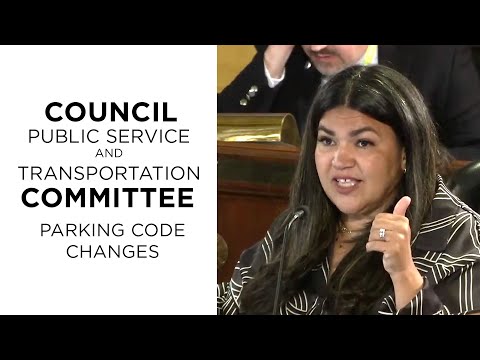
Columbus City Council heard a code-change presentation on proposed amendments to City Code Chapter 21.50 on Tuesday, during which Department of Public Service staff described a package of revisions meant to simplify appeals, calibrate fines and add safety-focused violations ahead of planned bus rapid transit corridors.
Justin Goodwin, administrator for mobility and parking services, said the division drafted the changes as an implementation item from an updated strategic parking plan intended to modernize operations. “We have an updated parking citation fines themselves for over a decade,” Goodwin said, arguing the code is cumbersome to administer and difficult for the public to read.
Amanda Ford, parking operations coordinator, summarized the central operational changes: the city would move from a 10-day response window before a penalty to a 30-day window, introduce a tiered fine structure with an early-payment discount and simplify the appeals process so residents either pay or request a hearing within 30 days. Ford said, “Right now, you get 10 days before a penalty is added. We’re moving that to 30 days.” She said an early-payment discount would be available in the first seven days after issuance.
The proposed fine framework separates violations into three categories: higher fines for safety and mobility violations (for example, parking in bike lanes or bus lanes), intermediate fines for parking-management categories such as meter nonpayment and permit parking, and lower fines for general, low-impact violations. Goodwin noted the Ohio Revised Code caps municipal citations at $100, except for parking in a handicap space, which state law allows to be as high as $500.
Staff said they will remove language that currently allows loading and delivery activities in protected bike lanes and will add a new infraction prohibiting stopping or parking in bus lanes, in anticipation of future Link Us bus rapid transit (BRT) corridors. As Azlyn Rodriguez, senior director of regional strategic partnerships at the Central Ohio Transit Authority, told the council: “For BRT to work as intended, dedicated bus lanes must be kept clear.” COTA offered explicit support for clarifying enforcement authority around bus-only lane restrictions.
Ford and Goodwin also described administrative changes to the failure-to-register/display tickets: the city will split that single offense into two distinct violations, provide a warning within 30 days of a recently expired registration, lower the fee for that offense from $50 to $30 and prevent continuous escalation for repeated short-term registration lapses. Staff said the change is intended to reduce cycles in which registration holds compound municipal penalties and BMV restrictions.
On enforcement mechanics, staff described current practice and limits: parking operations primarily patrol high-demand parts of the city (downtown, Short North, University District, East Franklinton), Columbus Police can issue tickets elsewhere, the city uses license-plate recognition and handheld devices, and three unpaid tickets can make a vehicle eligible for towing. For residents owing more than $100 in tickets, the city offers a payment plan that can extend up to 12 months.
Goodwin said the amendments will be introduced for first reading next week, be returned for a second reading and a vote on Dec. 15, and—if approved—would take legal effect in January with operational changes to citation fine administration likely phased in by April after vendor and police coordination. Staff described a public-education effort planned for early 2026, including updated ticket text and vendor messaging through ParkMobile and meter kiosks.
Council members asked about language access, reporting mechanisms and the city’s decision not to use boots (vehicle immobilizers) broadly; staff said they will use language services for hearings, encourage 311 or parking services contacts for reporting and reserve immobilization for narrow circumstances citing safety and turnover concerns.
The hearing drew four pieces of written testimony in support of the changes and one public comment from COTA. Chair Barroso de Padilla closed the session by thanking staff and attendees and reiterating the schedule for readings and outreach.