
Leon Valley council continues first-read discussion of PDD zoning worksheet and scoring criteria
Get AI-powered insights, summaries, and transcripts
Subscribe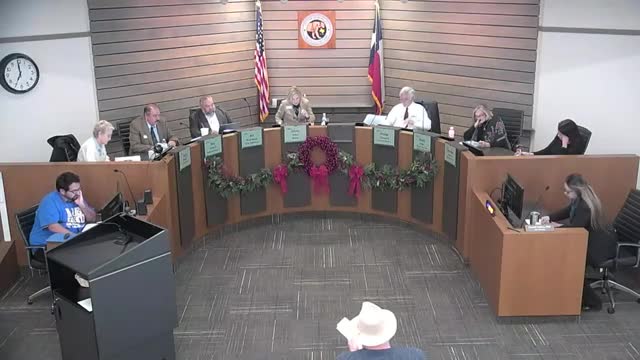
Summary
On first reading, councilors and staff debated a point-based Planned Development District (PDD) worksheet that would score applications on open space, heritage tree preservation, trails, affordable units, sidewalks, EV charging and stormwater. Staff will recirculate a revised worksheet and council members were asked to submit a minimum passing score before the next meeting.
City planning staff and councilors spent the Dec. 2 meeting discussing a proposed amendment to Chapter 15 (zoning) to introduce a Planned Development District scoring worksheet that would determine whether a project qualifies to come before council.
City staff said they would "take this in chunks" and asked council to set point values for individual criteria before selecting a minimum passing score. Councilors debated whether variances should be penalized (negative points) or simply receive zero points and discussed stacking penalties for multiple variances. Several items drew particular attention: preservation of heritage trees, trail-connection requirements, a modest affordable-housing set-aside, sidewalk frontage and bicycle parking, EV-charging provisions, green-building certification, stormwater treatment and screening to avoid blank walls.
Councilors reached tentative agreement on several numeric adjustments — for example, reducing maximum points for some open-space items, setting heritage-tree preservation at 15 points, reducing trail-connectivity points to 5, setting affordable units at 5% for partial credit, and raising sidewalk points to 10. They agreed to keep bicycle parking and EV‑charging incentives at 5 points each but noted implementation and maintenance concerns (who maintains trail connections or pays for EV infrastructure). Several councilors urged clearer, less "fluffy" ordinance language so developers must demonstrate compliance rather than rely on vague phrasing.
Staff asked council members to return a recommended minimum passing score (examples cited ranged from 65 to 80) and said she would rework the worksheet and email an updated draft in advance of the next meeting. Staff described the process as a screening step: applicants must score at least the minimum on the worksheet to have their PDD brought to council; if they fail, staff will ask them to "go find more points." Staff and council mentioned that appeals would proceed through existing variance/board-of-adjustment procedures and that the city attorney would review post‑draft language.