Get Full Government Meeting Transcripts, Videos, & Alerts Forever!
Get email alerts on the Housing topic
No spam. Unsubscribe anytime.
Lake Oswego council adopts policy to affirmatively further fair housing
Summary
After staff described a single-sentence comprehensive-plan amendment and a long council discussion on implementation and outreach, the Lake Oswego City Council unanimously enacted Ordinance 2967 to add an affirmatively furthering fair housing policy (policy B5) to the housing chapter.
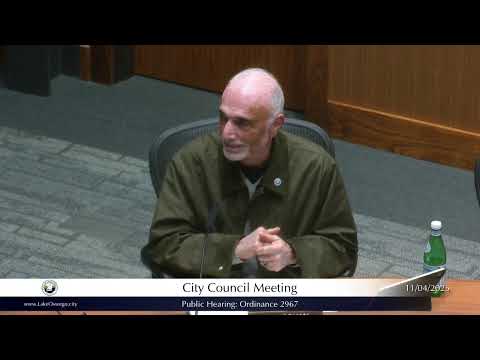
The Lake Oswego City Council on Nov. 4 unanimously enacted Ordinance 2967, adding a one-sentence policy to the city’s comprehensive plan to affirmatively further fair housing. The ordinance, identified in staff materials as policy B5, was approved 6–0 after a staff presentation, council questions and a single public testimony.
Long Range Planning Manager Eric Olsen told the council the proposal is a short, policy-level addition that formalizes the city’s commitment to “foster inclusive communities, overcome disparities in access to community amenities, and enhance housing choice” for populations including those protected under state and federal fair housing regulations. Olsen said the policy is meant to be applied as a decision-making “lens” when the city evaluates future land-use actions and to make the city’s existing work on equitable housing outcomes more visible in staff reports.
Olsen framed the proposal against federal and state requirements: the federal Fair Housing Act (1968) forbids housing discrimination, and Oregon adds implementation through statewide planning Goal 10 and other statutes. He also tied the policy to Lake Oswego’s recently adopted Housing Production Strategy (strategy 13), noting the policy’s education component will continue through 2028 and that a required, larger “analysis of impediments” will be completed as part of the city’s contextualized Housing Needs Analysis in 2029.
Councilors pressed for concrete examples of how the policy would change decisions. Olsen cited possible applications such as weighing affordable housing location to avoid reinforcing segregation, considering park siting to address amenity access, or acknowledging tax-abatement programs for affordable developments as initiatives that could be evaluated under the new policy. He emphasized that the amendment is not itself a land-use action but a policy tool that supports other implementation efforts.
Several council members said the city already pursues actions that further fair housing—citing rezonings for middle housing, public funding for housing projects and past developments such as Mountain Park—and urged stronger communication and neighborhood education so residents understand how policy translates into projects. Cynthia Johnson, who participated by Zoom and said she served on a prior Middle Housing advisory committee, urged support for the amendment and noted the Planning Commission recommended a small wording change.
Mayor Buck said if the ordinance is approved, staff will return with findings at the next council meeting on Nov. 18. Councilor Afghan moved to enact the ordinance; the motion passed 6–0. Olsen and staff reiterated that the educational work and implementation details will continue beyond adoption.