Get Full Government Meeting Transcripts, Videos, & Alerts Forever!
Get email alerts on the Crc Redevelopment topic
No spam. Unsubscribe anytime.
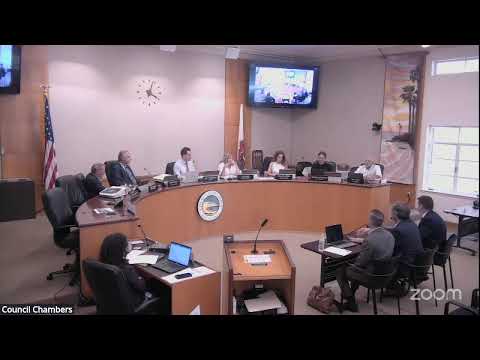
Consultant says CRC land could unlock millions for Laguna Beach; council weighs overlay to preserve options
Summary
Tri Commercial presented valuation scenarios for the 6.3‑acre Community Recreation Center site and two redevelopment concepts (approx. 126 units on half the site, or ~270 units full site). Consultants recommended rezoning/overlay to preserve flexibility; council signaled interest in an overlay while seeking to preserve the existing gym and explore partial housing to meet RHNA obligations.
Consultants told the council Laguna Beach’s Community Recreation Center (CRC) parcel is valuable under multiple scenarios and could generate material proceeds to fund civic reinvestment, but any redevelopment must account for prevailing‑wage and affordable‑housing requirements that reduce net land value.
Ed Del Bacarro of Tri Commercial summarized his land‑valuation work and hypothetical development scenarios for the 6.3‑acre site. He presented two illustrative concepts: a smaller redevelopment of roughly 126 residential units on half of the property that preserves the CRC gym and program space, and a larger full‑site concept of about 270 units. Del Bacarro said the site’s constrained topography yields limited developable square footage (roughly 76,000 buildable square feet if the entire site were used; about 35,000 square feet for a half‑site scenario) but that scarcity in Laguna Beach keeps market interest strong.
On values, Del Bacarro offered order‑of‑magnitude figures: a half‑site “as‑is” market value roughly $27–28 million, netting roughly $21 million after an illustrative 30% reduction for prevailing wage and affordable‑housing obligations; with entitlements the half‑site value could reach $37–46 million in his scenarios. Del Bacarro estimated the whole‑site entitlement value and said net proceeds—depending on options chosen—could generate $20–40 million in community benefit. He recommended rezoning to the maximum permitted height/density consistent with the city’s 30‑foot limit to preserve flexibility for developer solutions.
Councilors repeatedly stressed the desire to preserve key recreation uses (notably the existing gym) while exploring options to meet the city’s RHNA (Regional Housing Needs Allocation) shortfall. Several council members expressed support for initiating an overlay zone process to lock in potential entitlement value while preserving future options. The council discussed targeted approaches such as preserving the gym and surface field in any redevelopment, pursuing a partial entitlement/overlay, and using an RFI (request for ideas) to solicit development proposals rather than committing to a single design.
Public commenters and neighborhood groups flagged concerns about losing green space and urged robust resident engagement. John Thomas read a letter from the South Laguna Civic Association asking the council to prioritize resident participation and to resist intensification that would eliminate Lang Park’s role as South Laguna’s only local play field. Nancy McKenna, a neighbor to the CRC, said she was “horrified” by the visual loss when portions of the field had been converted to parking and urged the city to protect beaches and green space rather than adding more parking or large‑scale development.
Next steps: councilors signaled interest in staff bringing back a recommended overlay process and additional due diligence that preserves the gymnasium and considers partial housing options tied to RHNA obligations; no sale or entitlement decision was made at the study session.