Get Full Government Meeting Transcripts, Videos, & Alerts Forever!
Get email alerts on the Wastewater Financing topic
No spam. Unsubscribe anytime.
Middleton outlines $140 million wastewater upgrade, warns of multi‑year rate increases
Summary
City staff presented a phased wastewater treatment plan to meet new TMDL limits, estimating roughly $140 million in capital needs and a proposed $64 million bond; officials said connection and impact‑fee revenue plus borrowing will shape multi‑year rate increases and timing for expansions.
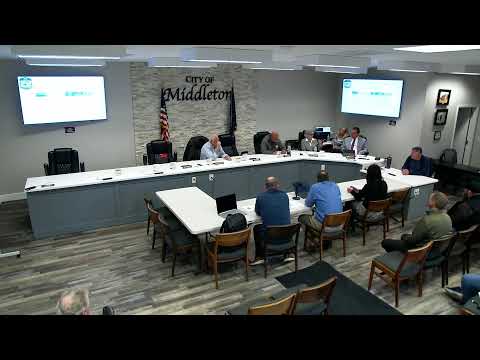
Middleton city staff and outside consultants on Thursday laid out a phased plan to upgrade the city’s wastewater treatment system to meet state and federal water‑quality requirements and to accommodate projected growth.
Public works director Jason Van Gilder told the council the city’s current plant can handle a little over 8,000 connections and that the initial phase of the new plant would raise capacity to roughly 9,500–10,000 connections. “We are now at 8,000 today,” Van Gilder said as he explained the demand side. He said high‑end growth projections used in prior plans could push the system toward roughly 14,000 connections — roughly 40,000 people — but that the city is planning incrementally so expansions can follow demand.
The city’s capital forecast, Van Gilder said, shows total program spending of about $140,000,000 over the next two decades to build the initial project, subsequent expansions and related capital items. To fund the work staff described a borrowing plan that would include an approximately $64,000,000 bond, repaid over decades. Van Gilder said the city will apply to the Idaho Bond Bank and that one modeled option would use interest‑only payments for the first two or three years to ease near‑term rate pressure.
Council members and staff repeatedly emphasized the tradeoffs between growth, connection‑fee revenue and monthly rate increases. Under the baseline model staff showed, a typical monthly sewer bill is nearer $70.80; under slower growth or lower connection‑fee revenue, the model projects larger, front‑loaded increases — for example, multi‑year steps in the midteens percent — before settling back to smaller annual increases.
On funding tools, staff distinguished connection fees (a buy‑in that lets new customers purchase existing capacity) from impact fees (charges to fund new capacity). Van Gilder cited the city’s recent decision to adopt a connection fee near $15,000 per connection, reflecting a prior consultant study, and said an interim impact fee for the first expansion would be roughly $10,000 per new connection in the initial project. “We’ve been collecting that for the last year and now,” he said of connection‑fee revenue.
Staff also flagged regulatory drivers. The upgrades are intended to satisfy a Total Maximum Daily Load (TMDL) constraint for phosphorus and other limits imposed through state permitting (IDQ) and federal Clean Water Act programs. The presentation noted that the judicial confirmation used earlier to authorize ordinary and necessary work covers the initial upgrades but would not cover later expansion phases; those will need separate funding pathways.
What happens next: staff said bids for construction are expected in the coming months (bids likely in February–March), and final rate settings will return to the council in mid‑year (staff projected June–August) once bids and bond terms are known.