Get Full Government Meeting Transcripts, Videos, & Alerts Forever!
Get email alerts on the Utility Rates topic
No spam. Unsubscribe anytime.
Meridian council reviews utility-rate options; staff recommends gradual shift to higher fixed fees
Summary
City Director Lorelei McPhee presented a health check of the enterprise fund and recommended a phased '9-4-3-1' rate plan to shift more costs to base fees, improving long-term solvency while keeping Meridian's rates below Treasure Valley averages; council asked questions but did not vote.
Lorelei McPhee, director overseeing Meridian’s enterprise fund, presented the council with a 10-year financial model and the results of a 2024 cost-of-service study at the Nov. 12 work session.
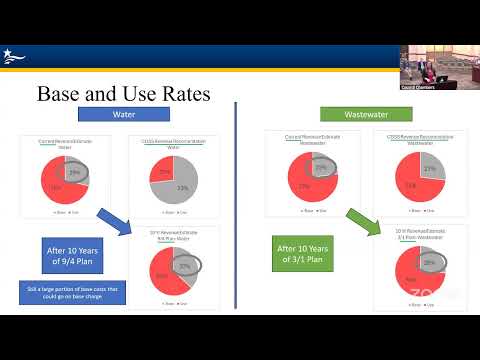
"We are the lowest rates in the Treasure Valley by a lot," McPhee said, and noted the city’s low rates reflect prior conservative planning and a debt-free posture. She told the council that Meridian currently allocates about 29% of water-system costs to base fees (the study identified true base costs near 73%) and about 23% of wastewater costs to base fees (study ~27%). Because average per-household water use has declined due to more efficient fixtures, the city is collecting less revenue via usage charges while fixed system costs remain.
McPhee presented three paths: a) a single 3% across-the-board increase for fiscal year 2026; b) a phased approach she described as the "9-4-3-1" plan (shifting a higher share of charges onto base fees over time), which she said would amount to an approximate 2.6% increase to the average customer in FY26 and move water base allocation from 29% toward 37% over 10 years; and c) a one-time larger adjustment (roughly a 9% increase to water and 1% to wastewater) that would achieve five-year solvency but have a larger immediate customer impact. She modeled impacts for low, average and high users and said the phased plan would keep Meridian’s average monthly bill below current Treasure Valley averages even after ten years.
Council members broadly supported a gradual approach. Councilman Overton said he favored the "9-4-3-1" plan for longer-term solvency; Councilman Taylor and others asked whether shifting more revenue to base fees could blunt customer incentives to conserve water. Mayor Simison raised concerns about residents who invested in solar or other conservation measures and whether a change in rate design would alter the reward for those investments. McPhee responded that the city could monitor usage trends and that tiered rates are more effective for conservation if that becomes a priority.
McPhee said the city will publish the proposed rate change on utility bills and plans a public hearing in mid-December with an effective date of Jan. 1 if adopted. No formal vote on a rate change was taken at the Nov. 12 work session.
Next steps: staff will finalize communications for utility bills, hold the public hearing, and return with any revisions following public input.