
McCall to explore two housing projects on city land with LEAP Housing
Get AI-powered insights, summaries, and transcripts
Subscribe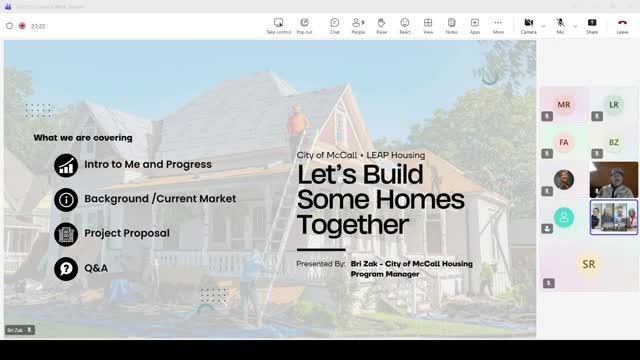
Summary
City staff and nonprofit LEAP Housing asked the council to authorize feasibility work for two projects on city-owned parcels: a 30-unit LIHTC rental infill and a lower-density 16-unit ownership project on Flynn Lane; council signaled support to pursue feasibility and funding options.
McCall city staff and Boise-based nonprofit LEAP Housing presented two proposed developments on city-owned land and asked the City Council to authorize staff to explore feasibility and funding. The projects would include a 30-unit Low-Income Housing Tax Credit (LIHTC) rental infill on the civic campus and a roughly 16-unit local homeownership project on Flynn Lane.
The city’s new housing program manager, Brie, described the initiatives as preliminary ‘‘first touch’’ proposals intended to test council interest before staff and the developer prepare formal applications. ‘‘We believe that this would be an excellent location for a 30 unit downtown infill project,’’ Brie said, citing proximity to services and the project’s potential competitiveness for tax credits because the land would count as a monetary contribution.
Why it matters: McCall faces a local affordability gap the staff said is driven by a tight market and high prices. Brie told the council that deed-restriction and ground-lease tools already in use have produced 15 occupied deed-restricted homes and that about 39 more deed-restricted homes are coming soon under existing programs. She also said roughly 45% of McCall residents earn under $50,000 a year and that typical rental listings cluster near $2,000 per month — a level many local workers cannot afford.
LEAP Housing’s founder, Bart Cochran, framed the partnership as necessary to make competitive LIHTC applications in a market that doesn’t receive bonus points tied to federal designations (for example, McCall is not designated a qualified census tract). ‘‘We’re with you in this, and we hear your desire to create this type of housing, and we wanna see it happen,’’ Cochran said, noting LEAP’s statewide experience developing both rental and ownership projects.
Timing and funding: Staff and LEAP explained the LIHTC application cycle is highly competitive. The state round opens in mid‑year; LEAP said an August application round is a target and that, if awarded, LIHTC-funded construction typically begins the year after award (staff said the earliest feasible construction season for the LITEC project would be 2027). The smaller homeownership project could move faster — staff estimated a possible construction start in 2026 if financing and partner arrangements come together.
What was decided: Council members expressed general support for staff to proceed with feasibility work and to pursue funding strategies, including using city land as a contribution to strengthen applications. No formal funding or contract approvals were made; staff said they will return with more detailed analyses, redlines and specific recommendations at future meetings.
Context and next steps: The presentation reviewed local tools — ground leases, deed restrictions with income/appreciation caps, and small developer incentives — and noted practical constraints (topography at the civic campus site, parking and snow-management considerations). Staff and LEAP committed to continued outreach with neighbors and additional design and entitlement analysis before bringing specific ordinances or agreements back to the council.