Get Full Government Meeting Transcripts, Videos, & Alerts Forever!
Get email alerts on the Transportation Speed Limits topic
No spam. Unsubscribe anytime.
North Bend council asks ODOT to cut a 45 mph segment on Highway 101 to 40, urges consideration of 35
Summary
After extensive public comment and staff input, the North Bend City Council voted to accept ODOT's speed study recommending a 45→40 mph reduction on US Highway 101 through the city and asked ODOT to consider lowering the segment to 35 mph; the motion passed with one councilor recorded as opposed.
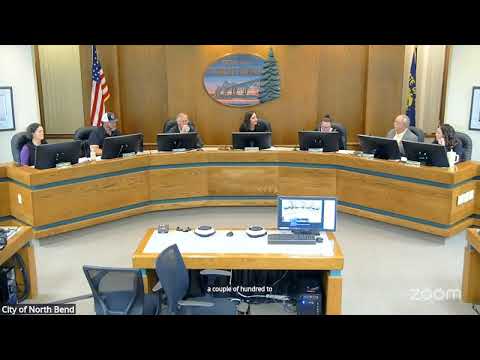
The North Bend City Council on Oct. 28 voted to accept the Oregon Department of Transportation's speed study for US Highway 101 through North Bend, endorsing a reduction of a 45-mph segment to 40 mph and formally asking ODOT to consider a further reduction to 35 mph.
The vote came after more than an hour of public comments, council discussion and questions for traffic staff. Members of the public urged lower posted speeds; Mike Powder of Coos Bay told the council, “I personally think there should be a maximum 30 mile an hour speed limit in all city limits,” and a resident who identified himself as Bert described multiple on-street hazards and recent local fatalities and urged protective action.
Why it matters: Council members framed the decision as an effort to improve pedestrian and turning safety on a stretch of Highway 101 that runs through the city’s commercial corridor and near new businesses and increased foot traffic. Councilors cited competing factors — higher truck volumes, enforcement limits, and driver behavior — but said a consistent flagged speed through the corridor could reduce speed variance and improve safety.
What the council heard: A traffic officer who responded to council questions said he makes thousands of traffic stops annually for speeding and cautioned that lower posted limits do not eliminate speeding, but can reduce observed speeds for a majority of drivers. Council members discussed enforcement capacity, the 85th-percentile engineering standard referenced in the ODOT study, and whether physical changes (signals or crosswalks) and private funding for improvements might be necessary alongside a posted speed change.
The motion, moved by Councilor Slater and seconded by Councilor Jones, passed by voice vote with one council member recorded as opposed. Council and staff agreed the decision is a recommendation to ODOT — the state agency retains final authority to set and sign speed limits — and asked staff to include a request that ODOT consider 35 mph for consistency through the zone and to pursue any feasible engineering changes that would support a safer corridor.
What happens next: The city will forward its formal comment and request to ODOT. Staff also were asked to review crosswalk locations and possible engineering solutions at specific intersections raised during the discussion. The council explicitly recorded the city's request; ODOT will review the study, the city's recommendation and any additional local data before making a final signing decision.