Get Full Government Meeting Transcripts, Videos, & Alerts Forever!
Get email alerts on the Water Rates Irrigation topic
No spam. Unsubscribe anytime.
Norwalk council approves first reading to simplify irrigation rates after heated debate
Summary
On Oct. 16, Norwalk City Council approved a first reading to replace a three‑tier irrigation rate with a flat 1.5 multiplier, a move staff says simplifies billing and reduces unintended HOA penalties but would lower projected irrigation revenue by roughly $100,000 a year. Council voted 3–1 to advance the ordinance to later consideration.
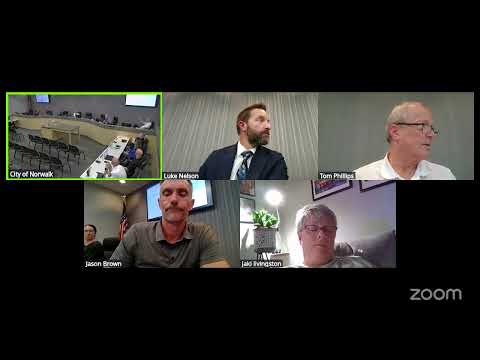
Norwalk — The Norwalk City Council on Oct. 16 approved the first reading of an ordinance that would change irrigation water billing from a three‑tier structure to a single flat rate set at 1.5 times the base water rate.
Staff said the change responds to unintended effects of the tiered system that disproportionately pushed many homeowners associations into the highest, double‑rate tier. Jean, the city staff member who presented the item, told the council the proposal “is not about increasing revenues and making money. We're just really trying to recover our costs, as much as possible, as much as reasonably possible.”
Luke, a staff analyst who ran HOA consumption figures for the city, said the tier thresholds were set too low and that many HOAs were “being penalized because they were a larger group altogether.” He told the council staff compared HOA consumption as if each home had an individual meter and found HOAs could face an added per‑unit cost that ranged widely depending on usage patterns.
On the revenue side, staff presented estimates based on 2024 numbers showing irrigation billing would fall from about $800,000 under the prior structure to about $700,000 under the proposed 1.5 multiplier, a roughly $100,000 annual reduction. Staff also told the council the city attributes roughly 32% of current water system costs to irrigation and expects that share to grow to about 45–50% in coming years as Central Iowa Water Works expansion costs accrue.
Several council members asked whether non‑irrigating ratepayers were effectively subsidizing heavy irrigation users and whether regional coordination through Central Iowa Water Works or technology and nonpotable irrigation systems (sometimes called “purple pipe”) would be a better long‑term solution. One council member suggested education and technology mandates could reduce wasteful irrigation; staff said those options are being discussed regionally.
Councilmember Livingston cast the lone dissenting vote on the first reading; the motion to advance the ordinance passed 3–1 on roll call. Council members and staff said they expect to revisit irrigation pricing again after collecting more data and monitoring metrowide decisions by Central Iowa Water Works.
The ordinance will return to council for a subsequent reading and public input; staff recommended continuing outreach and reviewing the city's irrigation billing after one year with updated consumption data.