Get Full Government Meeting Transcripts, Videos, & Alerts Forever!
Get email alerts on the Infrastructure Subdivision Standards topic
No spam. Unsubscribe anytime.
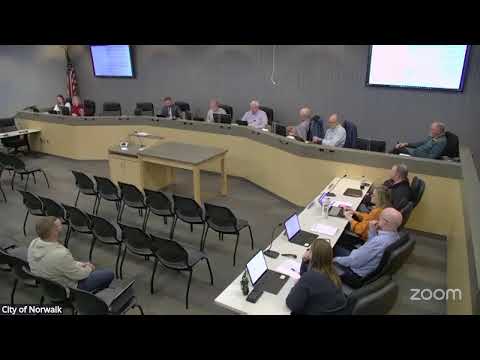
Norwalk council advances first reading to require subdrains, strengthen bonds for new streets
Summary
On Nov. 20 the Norwalk City Council approved the first reading of an ordinance that would require subdrains and a granular subsurface for new streets and revise bonding and warranty language; staff and developers debated timing, cost share and how the changes would apply to plats already in progress.
Norwalk City Council voted on Nov. 20 to advance the first reading of an amendment to Chapter 176 of the city code that would require subdrains and a granular subsurface for all new streets and revise warranty and maintenance-bond language for public infrastructure.
City staff said the measure responds to pavement performance studies and long-term lifecycle costs. "Their study was from HR Green," a staff presenter said, describing a presentation that compared older standards with higher foundation standards and showed a roughly four-to-one lifecycle cost savings from the higher standards.
Staff also described changes to bonding language intended to reduce developer concerns: the ordinance would permit either a single bond by the developer or multiple bonds allowing subcontractors to provide bonds, and it removes a requirement that staff described as a "joint payment" that had increased costs.
Developers and members of the public urged caution on timing and implementation. "From our perspective ... it's probably to cost more like 5 to 6%," said Dave Harmier of Vista Real Estate, describing the incremental construction costs his firm expects on a large subdivision. Developers also said construction schedules for projects such as Saddle Ridge make meeting a near-term compliance deadline impractical.
Council members discussed a phased approach and possible city cost-sharing for incremental costs to avoid disrupting developments already in progress. Staff said a likely annual average of 1.3 miles of new streets would translate to an approximate additional city cost of $450,000 if the city should bear 100% of the differential in a given year, a figure intended as an illustrative planning estimate.
Under the ordinance language presented, the new standard would apply to preliminary plats approved after Jan. 1, 2026; a related provision would bring final plats into compliance in the year following final-plat approval if construction begins after that date. Staff told council they would prepare a status report on active preliminary plats and their phase timelines for the next meeting to identify which developments would be affected.
Council approved the ordinance's first reading after debate; multiple council members emphasized they did not intend to waive future readings and wanted more time to consider cost-share mechanics and the bonding language. The ordinance will return for later readings before final action.
The council did not adopt a final policy on city cost-sharing; members directed staff to compile and report detailed lists of current preliminary plats, phase status and estimated timing so the council can evaluate transition and funding options at a future meeting.