Get Full Government Meeting Transcripts, Videos, & Alerts Forever!
Get email alerts on the Master Plan topic
No spam. Unsubscribe anytime.
Augusta Tomorrow presents '2035 Vision' master plan; North Augusta to review
Summary
Augusta Tomorrow presented a 10-year "2035 Vision" master plan that outlines four 'big moves'—a 5‑minute downtown, a green ribbon of trails, a rippled river edge and a canopy network—and sets measurable targets including 8,000 new residents by 2035 and a tree‑canopy rebuild after hurricane losses. North Augusta received the plan as information.
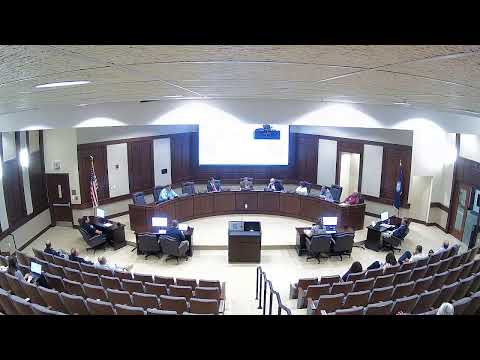
Augusta Tomorrow Executive Director Lauren Dallas presented the "2035 Vision" master plan to the North Augusta City Council on Monday, outlining a 10‑year strategy to strengthen downtowns on both sides of the Savannah River and improve connectivity between them. Dallas said the plan, funded in part by the city of Augusta, North Augusta, Augusta DDA, Georgia Power and Augusta Tomorrow, recommends four major initiatives: a "5‑minute downtown" model for daily amenities, a "green ribbon" to link trails in a five‑mile double loop, a "rippled edge" riverfront activation strategy and a citywide "Canopy Network" to restore tree cover.
Dallas presented measurable targets: 8,000 new residents across the study area by 2035 (not units), a doubling of downtown tree canopy and a 10‑degree reduction in urban heat in targeted areas. She described specific projects within the plan — including the Jones Alley pedestrian connection, a Reynolds Street traffic‑calming 'diet,' expansion of the Augusta Common, a Woodland Trail connection to the 5th Street Bridge and concepts such as floating piers, 'bargelets' for small riverfront vendors and a potential water taxi linking downtowns.
Dallas said Augusta Tomorrow conducted on‑the‑ground public‑life observations and online surveys and emphasized that much of the work will require partnerships with property owners and neighboring jurisdictions. She acknowledged the plan's flexibility — "the four big moves are very flexible" — and told council members North Augusta would receive the plan as a "receipt of information." Mayor John framed the effort as overcoming a river barrier rather than a wall, calling the idea "synergy" between the two downtowns.
Funding and implementation responsibilities vary by project. Dallas noted an earlier commitment of $35,000 in ARPA funds from a previous council and said Augusta Tomorrow covered a substantial portion of remaining planning costs after hurricane‑related fundraising shortfalls. She described potential near‑term priorities (the Common plus Jones Alley and the Reynolds Street diet) that should precede larger projects such as the undulating green.
The council asked about connectivity points between the cities and about earlier riverfront efforts. Dallas said the plan builds on prior studies (including a 2009 West Augusta vision) and engages public and private partners. She offered to share her contact information and invited council members and residents to participate in implementation conversations.
The plan has been formally adopted by the city of Augusta; North Augusta will consider the recommendations and, per the presentation, could partner on parking management and trail connections. Dallas closed by urging a sustained, cooperative effort to implement the plan over the next decade.