Get Full Government Meeting Transcripts, Videos, & Alerts Forever!
Get email alerts on the Tree Code topic
No spam. Unsubscribe anytime.
Lake Oswego considers new tree‑code rules to meet state clear‑and‑objective standards; council debates small‑lot exemptions, fees and appeals
Summary
Council received a lengthy presentation on tree‑code amendments aimed at preserving canopy while complying with Oregon clear‑and‑objective standards for housing. Key topics included percentage or DBH retention options, a small‑lot building‑envelope exemption, bonus credits for retaining native trees, fee‑in‑lieu calibration, appeals process changes and a proposed moderate‑risk removal path.
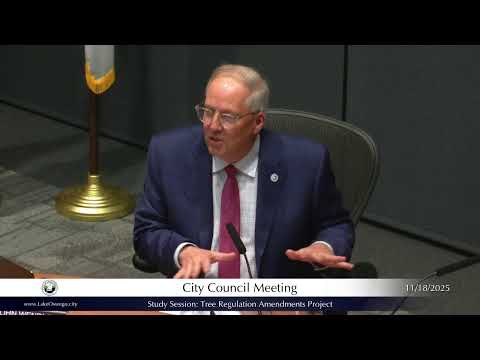
Lake Oswego councilors spent the bulk of their Nov. 18 meeting on proposed code changes to the city’s tree regulations meant to implement the Urban Community Forestry Plan and to comply with recent Oregon law requiring clear‑and‑objective standards for residential development.
Consultant Sarah Goldstein and Community Development Director Jessica Numanalou presented four substantive code concepts: (1) two clear‑and‑objective retention approaches for housing applications (retain a percentage of total trees on a lot or a percentage of total DBH); (2) targeted incentives for on‑site tree preservation; (3) revisions to the notice and appeals process to reduce delay for clear‑and‑objective applicants; and (4) clearer consistency between development and non‑development permitting with a proposed path for moderate‑risk tree removal.
"The objective of this project is to amend Lake Oswego's tree code and tree related provisions in the community development code as recommended by the urban community forestry plan update," Goldstein said, emphasizing the project’s intent to preserve the city’s wooded character while supporting responsible development.
Retention options and exemptions
Staff proposed offering developers an either/or choice to meet clear‑and‑objective requirements: maintain a fixed percentage of total trees on the lot or retain a fixed percentage of total DBH. The consultants framed those as ways to provide flexibility while ensuring measurable minimums. The team also proposed exempting trees within a building envelope for small lots — defined in the proposal as lots equal to or less than 5,000 square feet — so very small parcels are not rendered undevelopable by strict retention rules. Staff provided city data showing roughly 4,065 residential lots of 5,000 square feet or less and 1,869 such lots in the seven residential zones that have minimum lot sizes; R‑3 (high density) includes about 683 small lots.
Councilors asked for case studies and statistics to show how many trees would be affected under different percentage or DBH thresholds; staff acknowledged the importance of testing example lots before settling on numeric thresholds. Staff also noted the 15‑inch DBH threshold used historically (it’s the dividing line between Type 1 and Type 2 review in existing code) and said that using that threshold reflects an existing operational practice, though councilors asked for more data on how many trees would qualify as "significant."
Mitigation pricing and fees in lieu
Councilors raised a prominent concern about any fee‑in‑lieu option that would allow applicants to pay instead of meeting retention thresholds. Staff said mitigation fees should be calibrated to be a meaningful disincentive — citing examples such as Portland’s per‑inch fee — and floated making some categories ineligible for fee mitigation so large or avoidable removals would instead require discretionary review. Consultant/arboreal staff noted Portland's current mitigation metric (approximately $472 per inch, cited as an example in the presentation) as one comparable jurisdictional practice.
Incentives and stormwater credits
Staff presented several incentives to encourage on‑site preservation — including limited dimensional adjustments to setbacks or height, exemption from some public‑notice/appeal steps for high retention, and on‑site stormwater credits tied to retained canopy. Task‑force polling showed support for offering percentage retention options and for bonus credits for preserving native trees; smaller incentives such as dimensional adjustments drew mixed reactions from councilors who worried about neighbor impacts and administrative complexity.
Appeals and timing
Staff proposed shortening the notice and appeal window for clear‑and‑objective applicants (from three weeks to two) and routing appeals to a qualified hearings officer rather than the Development Review Commission, with a potential recommendation that the hearings officer decision be final. Staff noted appeals are uncommon — roughly three appeals per year on average, and eight appeals reached council between 2020 and 2024 — and that most appeals to council have not overturned previous decisions. Councilors split on the proposal: some favored a faster, professional hearings‑officer path to reduce delay and staff time; others argued elected oversight is important and preferred retaining the council appeal option.
Moderate‑risk removal path
To address homeowner safety and maintenance concerns, staff proposed adding a third exemption to allow removal of "moderate‑risk" trees where a qualified arborist documents the risk and alternatives do not reduce risk to low or where there is demonstrable history of similar failure nearby. The tree task force supported that option by a majority but members flagged potential for expanded removal if safeguards and definitions aren’t precise.
Mitigation and planting
Staff reported the city currently approves about 2,900 permitted removals annually and required roughly 689 replanted trees last year in Type 2 or verification permits; parks staff noted about 20,000 trees were planted citywide in the last year through parks and planting efforts. Staff said they will evaluate stricter mitigation requirements for more removal categories.
Next steps: staff will present council feedback to the planning commission on Dec. 8, then proceed to draft code amendments and return to council for a work session on proposed code language.