Get Full Government Meeting Transcripts, Videos, & Alerts Forever!
Get email alerts on the Trail Repair Little Traverse topic
No spam. Unsubscribe anytime.
Baird presents final design package for Little Traverse Wheelway "Miracle Mile" to Petoskey City
Summary
Baird and Associates presented a final design package for restoring the Little Traverse Wheelway’s one-mile "Miracle Mile" segment. Project manager Rory Anew summarized field investigations, groundwater monitoring, three design options and plans to deliver a bid package; EGLE funded part of the study.
Petoskey City heard a presentation from Baird and Associates on restoring the Little Traverse Wheelway’s one-mile “Miracle Mile” segment. Project manager Rory Anew, who led the study for Baird, summarized field investigations, engineering analysis and next steps toward issuing a construction bid package to the city.
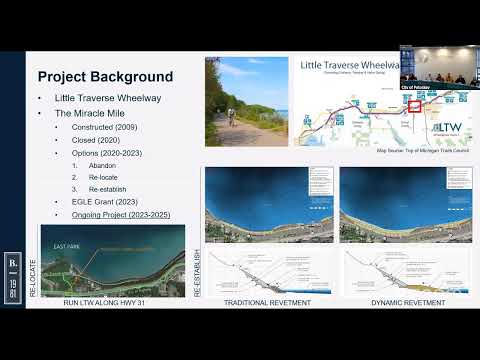
The presentation traced the project’s history and technical work. "My name is Rory Anew. I was the project manager for Baird throughout the course of the study," he said, and described five main tasks the team completed, beginning with field investigation. The team installed soil moorings and groundwater-monitoring instrumentation that have been in place for the past couple of years to better understand subsurface conditions.
Anew said the Miracle Mile was constructed in 2009 and later closed after repeated collapses and ongoing erosion made the segment unsafe. The study, which the presenter said has been underway since 2023, produced engineering analyses to identify drivers of failure and to test options for keeping the regional trail connected.
The team evaluated three principal options: abandoning the trailway, relocating it, or reestablishing the existing alignment with engineering measures to stabilize the corridor. Anew said Baird developed cost estimates and a final design package intended to be ready for the city to put the work out to bid; he emphasized that identifying construction funding and carrying out procurement were not part of Baird’s contract.
Anew also acknowledged outside support for the study: he said the Michigan Department of Environment, Great Lakes, and Energy (EGLE) provided financial assistance for a portion of the work. The presentation named other consultants who worked on the project, including a local landscape architecture firm referenced in the transcript as Beckett Raider and a consultant named Kim Newton.
No formal votes or motions were recorded during the portion of the meeting captured in the transcript. The presentation was paused because of microphone and audio problems before the session concluded its introductory remarks and next-step summary. According to Anew, the immediate next step is for Baird to deliver the bid-ready package to the city so officials can evaluate funding and procurement options.
The meeting resumed after a brief technical pause; the transcript ends before additional public comment or decisions on funding were recorded.