
Marion fire chief proposes $300 initial commercial inspection fee; council asks for tiers and data first
Get AI-powered insights, summaries, and transcripts
Subscribe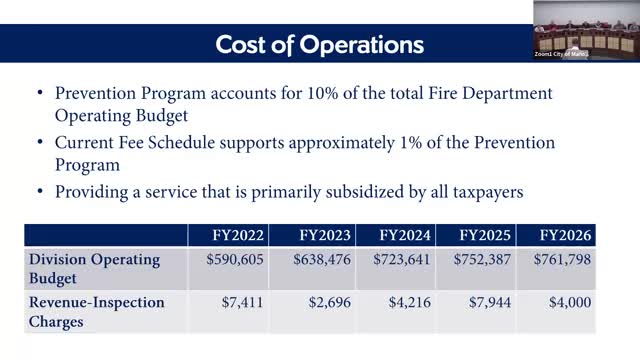
Summary
City fire prevention staff recommended a $300 flat initial commercial inspection fee (targeting 25% cost recovery) and additional charges for repeat reinspections; council supported starting the fee but asked staff to collect data, explore tiered rates by size/occupancy and return with refined options before full implementation.
The Marion Fire Department recommended that the City adopt an initial flat fee of $300 for commercial fire inspections as part of a move to recover a larger share of inspection costs and reduce subsidy from residential property taxes.
“Revenues through our current permits and fee schedule are at a 1% cost recovery rate,” Jason, a member of the fire prevention division, told the council, saying the department had worked with finance to model cost-allocation. He recommended starting at a 25% cost-recovery target using a flat $300 initial inspection fee and additional charges for repeat reinspections.
Under the proposal, the city would charge $300 for the first inspection, then $100 for a third visit and $200 for a fourth visit if multiple reinspections are necessary; staff said those additional fees would not be cumulative. The department proposes implementing the fee — if approved — on July 1, 2026, and reviewing the program annually.
Council members broadly supported the principle that businesses should bear inspection costs but raised fairness concerns about a single flat fee for businesses that range from small storefronts to large manufacturing facilities. Several members suggested a tiered fee structure by square footage or occupancy type; other council members emphasized not creating unintended burdens for small businesses or nonprofits.
Staff said the city recently implemented BSNA software to track inspections and expected richer data to inform future refinements. Council agreed to move forward with the staff recommendation as a starting point but directed staff to collect data, explore a simple tiered structure (for example, small/medium/large by square footage or thresholds such as 0–5,000; 5,000–15,000; 15,000+ sq ft) and return with options.
Next steps: staff to implement the initial fee recommendation as planned, monitor program performance, and return with tiering options and data-driven refinements to the fee schedule at a later date.