ANI outlines telework, space consolidation and facility costs as recruitment tool and budget pressure
Summary
Department of Administration & Information officials told the Joint Appropriations Committee telework has reduced turnover and created lease‑consolidation opportunities, but also creates costs (custodial, trades, utility, stormwater fees) tied to recent property acquisitions including the DEQ building; staff cited telework rates and turnover trends.
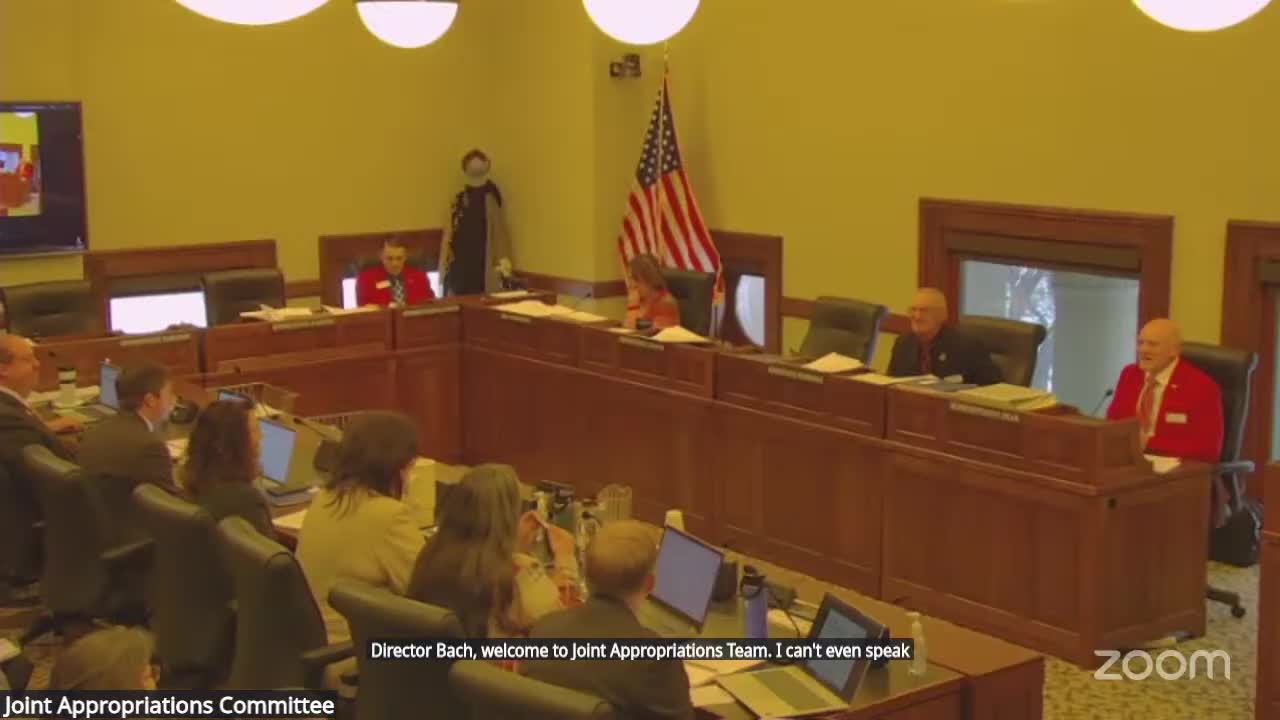
Patricia Bach, director of the Department of Administration & Information (ANI), and ANI staff briefed the committee on how telework, facility consolidation and service delivery intersect with the administration’s budget. ANI described telework as a tangible recruiting and retention tool: ANI reported telework metrics of 7.9% part‑time telework and 11.6% full‑time telework in ANI programs, and HRD said statewide turnover peaked at 24.8% in 2022 before falling to 16.3% in 2023 and has since trended back up.
Bach and HRD administrator Erin Williams said telework has produced cost‑saving opportunities, such as the ability to move agencies into shared spaces, reduce leases and streamline telephone/copier contracts. Andrew Coleman, ANI’s general services administrator, described a successful consolidation into Herschler/Hirschlow space that freed leases and produced estimated savings previously cited at about $150,000 in November estimates.
ANI also presented operational consequences of recent property purchases. The department acquired the DEQ building and two nearby houses; staff said the state’s internal operating costs (custodial, HVAC, trades) must increase to maintain the additional square footage. Coleman noted the DEQ lease had cost roughly $650,000 per year; after acquisition some line items move from agency lease budgets to the statewide cost allocation and the agency may still experience net savings after accounting for utilities and maintenance. ANI requested additional custodial/trades personnel and one‑time equipment purchases tied to those properties.
On capital and events, ANI described a footnoted $350,000 appropriation to keep the Capitol open one day per week (AWAC) and to support special events; legislators questioned the large footnote given historical expenditures (about $19,000 in prior biennium) and suggested revisions during markup.
On security, ANI asked to modernize key‑management and card‑access systems. Staff said the existing key/card infrastructure is expensive and partly proprietary; retrofitting older buildings to card access can be costly (examples cited that rekeying/door retrofits can run into the high hundreds of thousands or ~$1 million for complex buildings). ANI proposed modular upgrades and software (operate key module, Engage request) to automate work orders, key tracking and improve building security and space management.