Get Full Government Meeting Transcripts, Videos, & Alerts Forever!
Get email alerts on the Nonprofit Registration topic
No spam. Unsubscribe anytime.
City staff solicit public feedback on nonprofit registration, zoning and safety
Summary
City of Reno staff held a public webinar to gather input on whether nonprofits should register with the city, discussing zoning conflicts, inspection limits, a voluntary $25 registry and confidentiality concerns; staff will compile survey responses into a staff report for council review.
Lance Ferrato, director of licensing and code enforcement for the City of Reno, told attendees at a public webinar that the city is collecting feedback on whether nonprofit organizations should be required to register with the city. "At this point, that's all this is. This is just a discussion. We don't have any language drafting," Ferrato said.
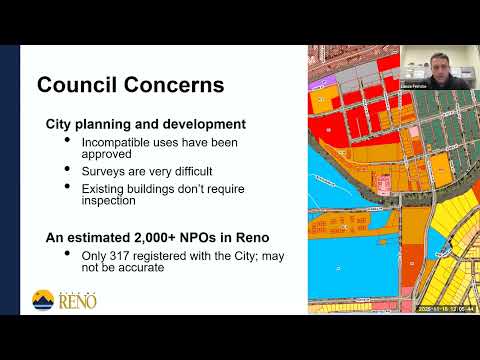
The discussion was the second of three outreach sessions aimed at gathering public comment and survey responses before staff prepares a report for the Reno City Council. Ferrato said the council asked staff to look at registration because of planning, zoning and public-safety concerns, including past instances where “incompatible uses have been approved next door to each other,” citing one example of a cannabis establishment located near a rehab facility.
Ferrato described the current status: Reno municipal code exempts organizations certified as tax-exempt under 501(c)(3) from business licensure, and the city maintains a voluntary registration. He gave an estimate of scale: "it's estimated that there's a little over 2,000 nonprofit organizations at this time, and the city only has 317 of those registered," and cautioned the 317 number may be out of date.
City staff outlined the practical questions under consideration: whether registration should be required, whether a fee should be charged (and whether it should scale with an organization’s size), whether inspection fees should apply, how enforcement would work, and what confidentiality protections would be afforded beyond state law. In response to chat questions, Ferrato and Alex Taylor, management analyst for the business license department, confirmed the current voluntary registration fee is $25 and does not include inspection fees.
Members of the public who spoke during the webinar expressed a mix of support for a public registry and concern about unintended consequences. "I am the founder and executive director of the Neighbor Network of Northern Nevada," said Amy, who urged that any registration form and terminology be tailored for nonprofits and not require listing a single "owner," which does not align with nonprofit governance. She added that tying fees to an organization’s operating budget could be misleading because nonprofit budgets typically represent grant-supported operations rather than profit.
Other attendees described practical constraints for smaller or location-free nonprofits. Johnny, who said his scholarship nonprofit has no paid staff and uses a PO box, asked why a registration fee should apply to groups without a physical presence. Erstan, cofounder of Soulful Seeds, said many programs operate at community sites and asked whether registration would require board access or onsite verification. Chip, with experience in nonprofit affordable housing and community aquatics projects, encouraged improving visibility of the existing voluntary online registration and keeping any fee nominal or waived, saying an enhanced voluntary registry might satisfy planning needs without creating burdensome new requirements.
Ferrato said enforcement in peer jurisdictions tends to be minimal and emphasized the city's likely approach would be to maintain information for planning and to help compliance officers identify locations, not to pursue aggressive fines. He also said he has consulted the secretary of state's office and acknowledged the city code may need clarification because several types of 501(c) organizations exist beyond 501(c)(3).
Next steps are procedural: staff will keep the survey open for additional responses, compile the public input and survey results into a staff report, and present findings to the City Council for direction before any ordinance or code language is drafted. Ferrato repeated the survey link in chat and invited emailed comments to blcode@reno.gov; he also noted the webinar recordings will be posted to reno.gov/businesslicensing and that the outreach series continues Thursday at 9 a.m.
The session included repeated requests that the city consider exemptions or different treatment for organizations that lack a brick-and-mortar presence and that confidentiality protections be considered for sensitive service providers. Ferrato said he would highlight those distinctions to council.