Get Full Government Meeting Transcripts, Videos, & Alerts Forever!
Get email alerts on the City Budget topic
No spam. Unsubscribe anytime.
Petoskey council begins first reading of 2026 budget, schedules Dec. 1 public hearing
Summary
City Manager Shane Horn presented a proposed 2026 operating and capital budget just under $39.01 million — down from roughly $40.44 million in 2025 largely because one-time grant revenue falls — and council set a Dec. 1 public hearing for second reading and potential adoption.
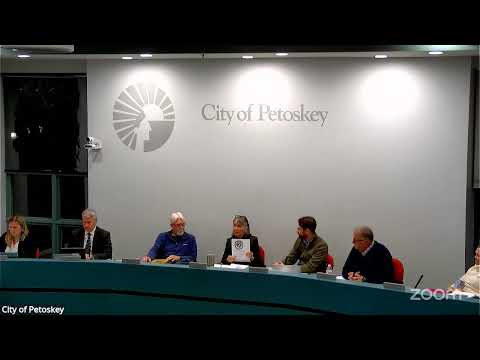
City Manager Shane Horn presented the City of Petoskey’s proposed 2026 operating and capital budget at the Nov. 17 council meeting and asked council to set a public hearing and second reading for Dec. 1.Horn said the combined 2026 operating and capital budget is ‘‘just under $39.01 million,’’ a decline from the current-year budget of about $40.44 million driven largely by a drop in one-time grant revenue that boosted the 2025 totals.
Horn reviewed major grant activity in 2025 that will taper in 2026, including a roughly $1,000,000 Maple Block Flats grant, $800,000 for slope-restoration design and other awards. He said grant revenue in 2026 is expected to fall to just under $1 million, and that some projects and grant-funded work will carry forward into the coming year.
Horn also updated the council on storm-relief costs and FEMA reimbursement. He said debris cleanup from the March 2025 storm totaled just under $1,000,000 and that total emergency-related expenses approach $1.168 million; staff currently projects about $825,000 in FEMA reimbursement (at a 75% reimbursement rate), but reiterated that category B reimbursement remains uncertain and FEMA proceeds are not built into the 2026 revenue assumptions.
On personnel costs, Horn proposed a 3% cost-of-living allowance for nonunion staff and reviewed the city’s health-insurance options and state cap rules for employer contributions. He told council the city locked in a 9.9% increase in its health plan renewal for 2026 by switching insurers last year, which moderates some cost pressure.
On pensions, Horn described continued investments in the Municipal Employees’ Retirement System (MERS) and recommended an ‘‘above-and-beyond’’ contribution of $400,000 in 2026 to help manage the city’s unfunded accrued liability; the council discussed past multi-year contributions and actuarial impacts on funded ratios.
Horn noted several capital priorities reflected in the draft: shifting funds to a marina dredging project (paired with a potential land-and-water grant), carrying forward $30,000 for a public-art project in 2026, investing in advanced metering infrastructure (AMI) for electric and water utilities, and targeted safety and building items such as elevator work at Public Safety East. He also described a proposal to purchase a jetter vehicle for sewer and water maintenance and to begin acquiring modular vehicle barriers for key street crossings.
Horn said the proposed millage rate would effectively roll back from 12.809 mills to an estimated 12.5119 mills because the Headley/Headlee inflation calculation dictates a rollback when taxable value increases faster than inflation; taxable value for 2026 is estimated to rise roughly 5% to about $779 million.
Council voted to publish notice and schedule a Dec. 1 hearing for the budget second reading and potential adoption. Horn asked council members to set up one-on-one meetings with finance staff if they want deeper line-item review ahead of the hearing.
What’s next: The council will hold a public hearing and second reading of the budget on Dec. 1. Staff recommended additional work sessions and one-on-one budget reviews with council members before the hearing.