Get Full Government Meeting Transcripts, Videos, & Alerts Forever!
Get email alerts on the Groundwater Levels topic
No spam. Unsubscribe anytime.
GSA adopts 5% minimum‑threshold option for groundwater levels, approves updated monitoring network
Summary
The GSA selected a 5% option for minimum-threshold protection of domestic wells, adopted refinements to the undesirable‑results definition, and approved an updated representative monitoring network of 10 wells. The consultant presented a domestic well inventory and mitigation cost estimates for planning.
The Windrock Creek GSA voted to adopt a 5% minimum‑threshold (MT) option for groundwater levels and approved updates to the monitoring network and related definitions, staff reported on Nov. 20.
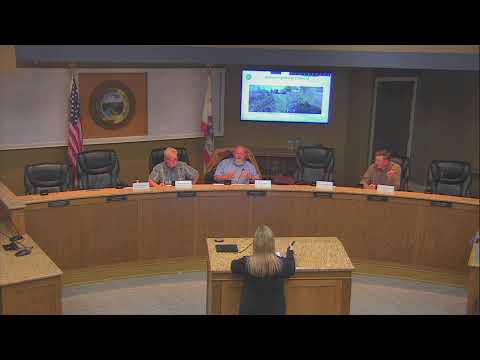
Becky Fairbanks, the GSA project manager, introduced the topic and said DWR had requested the GSA quantify how many domestic wells would be impacted under different MT choices. Consultant Laura Foglia (Larry Walker Associates) presented results of a domestic well inventory and a risk assessment. The consultant reported roughly 792 domestic wells on record in the database but noted significant uncertainties in older records; using conservative filters (excluding many likely inactive older wells and public‑supply areas) the team used 360 wells in the risk assessment.
Foglia explained the proposed approach: set minimum thresholds using whichever is deeper between (a) a percentile of nearby shallow wells (5th, 10th or 15th percentile) and (b) a specified buffer (historical low minus 20 feet). She said many representative monitoring sites would show long time horizons under current trends to reach deeper thresholds in most places, and provided mitigation‑cost illustrations (deepening or replacing a domestic well estimated at about $30,000 per well, a ballpark figure the consultant used for planning).
After discussion and with the advisory committee’s recommendation in mind, the board selected the 5% protection option (the WAC recommended 5% to limit mitigation cost exposure), approved the updated representative monitoring network map (10 wells: 8 original plus 2 added to better represent domestic‑well areas), and moved to amend the undesirable‑results definition to require monitoring at 2 wells or 25% of wells, whichever is greater, as the representative threshold for a two‑year condition.
Why it matters: the MT selection determines how many domestic wells the GSA would consider impacted under undesirable results and therefore affects projected mitigation obligations under SGMA (mitigation funding estimates influence long‑term planning and budgets). The updated monitoring network and revised definitions aim to improve the GSA’s ability to identify true management‑caused impacts versus local geology or isolated well failures.
Next steps: staff will finalize the monitoring‑network documentation, incorporate the board’s MT selection into the periodic evaluation and plan amendments, and develop a mitigation‑program approach and protocol for handling reported dry wells.