Get Full Government Meeting Transcripts, Videos, & Alerts Forever!
Get email alerts on the Blufftop Cdp Dispute topic
No spam. Unsubscribe anytime.
Bluebird Canyon CDP erupts into heated debate over ridge‑top design; chair prepares draft denial
Summary
Neighbors urged the board to deny a two‑story bluff‑top house at 1550 Bluebird Canyon, citing alteration of natural landforms and visual incompatibility. Applicant counsel said state housing law limits subjective denials and threatened legal action; the chair introduced draft CDP denial language but the transcript ends before a final roll call.
A protracted public hearing over a proposed house at 1550 Bluebird Canyon turned into the meeting’s most contested item on Nov. 13, with neighbors arguing the plan would substantially alter a natural landform and loom above the neighborhood, and applicant counsel warning that state housing laws restrict subjective permit denials.
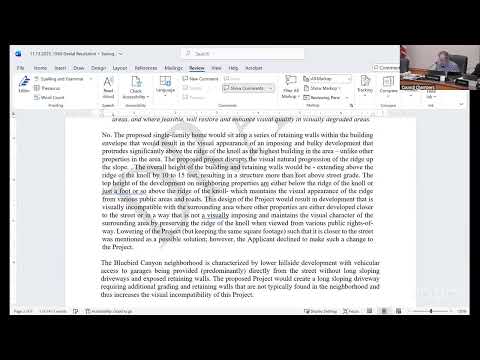
Neighbors packed the council chamber to urge the board to apply coastal development permit standards that protect natural landforms and the character of the hillside. Opponents said the house sits on the knoll, projects 10–15 feet above the surrounding ridge and would be visible across the neighborhood; they also raised concerns about access and fire‑safety standards for Bluebird Canyon Road. Several speakers asked the board to deny the CDP under Finding 1 (criteria 5 and 6): minimizing alteration of natural landforms and ensuring visual compatibility with surrounding areas.
Applicant counsel Morgan Gallagher told the board that state housing statutes (SB 450 and the Housing Accountability Act) greatly restrict the board’s power to apply subjective criteria, and at one point stated, “You must approve the projects tonight,” arguing denial would likely violate state law and invite litigation. Applicant architect and team also noted that prior slope repairs and coastal‑commission action on nearby parcels informed the allowable footprint.
After extended deliberation, Chair Gibbs said he could not make the CDP findings required by criteria 5 and 6 and introduced draft denial language tied to those criteria — focused on natural landform alteration and a lack of visual compatibility. The transcript records the chair introducing denial findings and staff preparing denial language, but a final roll‑call vote on the denial was not recorded in the available transcript.
Why it mattered: The Bluebird Canyon exchange showcases the legal and policy cross‑pressure faced by local planners: city and Coastal Act responsibilities to protect natural landforms and public resources versus state housing laws that narrow local discretionary review in the name of increasing housing supply. The public reaction and the chair’s draft denial signal that similar ridge‑top applications will be litigated or revisited with design changes.
What’s next: The board prepared draft denial language tied to CDP criteria 5 and 6 for this item. If the board finalizes a denial, the applicant is likely to appeal; if the board instead approves contingent on design changes, neighbors will expect substantial modifications such as lowering roof ridgelines, terracing into the slope, or relocating garage access.
Representative quotes: Morgan Gallagher, attorney for the applicant, said the board had limited discretion under state law and urged approval: “You must approve the projects tonight.” Chair Gibbs summarized his legal and policy concern in deliberations: he said he could not find that the application minimized alteration of natural landforms and was visually compatible with the surrounding area, and therefore prepared draft denial findings tied to CDP criteria.
Next procedural step: Staff prepared draft findings for a denial and the chair circulated proposed language; the board signaled its intent to act on those findings but the transcript ends before a recorded final vote.