Get Full Government Meeting Transcripts, Videos, & Alerts Forever!
Get email alerts on the Transportation topic
No spam. Unsubscribe anytime.
Council debates $20M Little Traverse Wheelway restoration; advocates offer fundraising and stopgap options
Summary
Council reviewed a $20 million engineering estimate to restore the collapsed Little Traverse Wheelway, debated alternatives including an upper-road bypass and phased engineering scenarios, and heard offers from private funders and the local Trails Council to lead fundraising while staff pursues interim safety solutions.
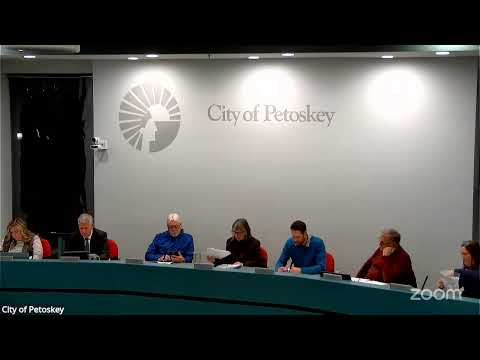
The Petoskey City Council spent more than an hour on Nov. 6 examining options to repair and restore the collapsed portion of the Little Traverse Wheelway. City staff presented an engineering study estimating a roughly $20,000,000 shoreline restoration, and council and the public discussed both large-scale restoration and lower-cost stopgap alternatives.
Brent Boland, speaking as a local trails advocate, told council there is private fundraising appetite and offered to help lead a campaign. "If I raise $20,000,000, you guys, at the same time, started, the plans together, raising the money, getting the permits — you'll build it if I get the money," Boland said, arguing community fundraising could unlock state and federal matching funds.
Several councilmembers urged a two-track approach: continue pursuing the comprehensive shoreline restoration while fast-tracking a safety-focused bypass or improvements to get users off the US‑31 shoulder sooner. City Manager Shane Horan said the 2026 capital budget includes $50,000 to further analyze alternatives and that construction of a limited bypass would likely cost in the "hundreds of thousands," not millions, depending on the option.
Opponents of immediately moving to an upper-road realignment noted prior studies that found north-side alignments constrained by right-of-way, utilities and signage and warned that an apparently cheaper alignment had previously been estimated at $7.5 million once crossings and a tunnel were included. Multiple councilmembers recommended further value‑engineering of the Baird study — asking the consultant to model lower-cost scenarios such as reduced rock quantities or alternate construction assumptions to test tradeoffs.
Why it matters: The wheelway is a high‑profile public amenity with safety implications where users now ride on the shoulder; the council must balance a high-cost, long-term restoration with immediate safety needs and limited municipal budgets.
Next steps: Staff will work with the trails council and private partners to explore fundraising, ask the engineering firm for lower-cost scenario modeling, and pursue interim safety measures (bollards, targeted crossings or a bypass) that could be implemented sooner.