Get Full Government Meeting Transcripts, Videos, & Alerts Forever!
Get email alerts on the Policing Accountability topic
No spam. Unsubscribe anytime.
Residents press La Marque council over police conduct; debate grows over Citizens Police Academy alumni MOU
Summary
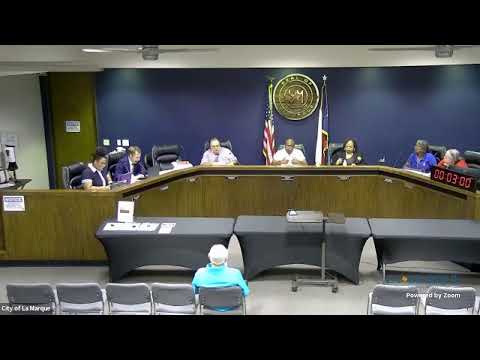
Multiple La Marque residents used the Oct. 13 public‑comment period to accuse officers of harassment, improper stops and searches, and inconsistent discipline. Councilors debated whether to press a private 501(c)(3) alumni association to sign a memorandum of understanding or to restrict its use of city facilities if it refuses.
Multiple residents raised allegations of misconduct by Lamarck/La Marque police officers during the public‑comment period at the Oct. 13 council meeting, pressing the council to question police leadership and to consider stronger oversight or personnel changes.
Who spoke: Several speakers named specific officers by badge or described repeated stop‑and‑search encounters. Joseph Mose said he was handcuffed and searched after an officer claimed he smelled marijuana, and said the district attorney later dismissed charges after reviewing dashcam footage. Tammy Garrett, a 31‑year law‑enforcement veteran, and others said they had raised concerns directly with the chief and asked the council and city manager to intervene.
Representative quotes: Nicholas Rokey, one of the first commenters on finance and governance, told the council the city had shown "repeated violations, willful negligence, and a betrayal of the public trust." On police conduct, one resident said, "The community policing, that's crap," a direct expression of frustration heard repeatedly in public comments.
Council response and the Citizens Police Academy issue: Council discussed a separate but related controversy over the Citizens Police Academy Alumni Association (a private 501(c)(3)). Council Member Yancey and others argued the alumni association has been excluding members and tolerating harassing behavior; they asked why the group had declined to sign an MOU with the city. Chief Aragon and staff said the alumni had been invited to execute a standard MOU in prior years but declined, citing its nonprofit status; interim City Manager Barbara Holly said she had waived the requirement temporarily because the group did not use city storage or facilities in a sustained way.
Legal limits and next steps: City attorney staff advised council that the city cannot force a private 501(c)(3) to enter into an MOU; council can, however, by majority vote, restrict the group's access to city storage, meeting spaces or other city resources if the group refuses to agree to terms. Council urged administration to attempt an administrative reconciliation: meet with alumni leadership, request bylaws and membership records where appropriate, and return to council with options. Council Member Yancey said she would continue to press for an MOU and for the administration to convene a meeting with alumni leadership; the chief said he would provide background on the group's membership and liaison arrangements.
Why it matters: The dispute ties community trust in policing to city oversight and to how volunteer or alumni groups affiliated with government bodies are supervised when tensions rise. Several citizens said the allegations of selective enforcement and hostile encounters are undermining trust in public safety institutions and urged council to move quickly.
What council directed: Staff were asked to collect the alumni bylaws, explain membership suspension/removal procedures, confirm whether the alumni store city equipment or use city facilities, and try to convene a mediated meeting. Council asked the city manager and police chief to bring the matter back to the council if the alumni refuse to engage in good‑faith talks.