Get Full Government Meeting Transcripts, Videos, & Alerts Forever!
Get email alerts on the Property Maintenance topic
No spam. Unsubscribe anytime.
Oregon City looks at tougher property‑maintenance standards, registry option for derelict commercial buildings
Summary
Commissioners discussed adding commercial property‑maintenance standards similar to the residential registry, favoring objective, visual triggers (boarded windows, roof, gutters) and a stepped enforcement approach; staff will return with a prioritized list and draft code options.
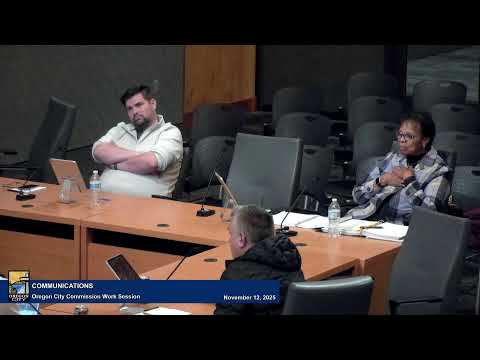
Oregon City commissioners discussed potential new rules for vacant and distressed commercial properties during a Nov. 12 work session and asked staff to return with specific code language and a prioritized list of property‑maintenance items.
Staff reviewed parts of the Oregon City Municipal Code (15.11 and 15.25) and presented examples from other jurisdictions, including Lincoln City and Portland, to illustrate approaches. Several commissioners said they do not want regulations to be punitive but to encourage property reuse and reduce blight. One commissioner framed the problem succinctly: many downtown commercial buildings have been in disrepair for decades and neighboring properties suffer the consequences.
“Most of the other ones, we're we're talking more about the property rather than the building,” one commissioner said while comparing examples. Commissioners coalesced around beginning with objective, easily measurable triggers — boarded windows exceeding a defined number of days, roof and drainage failures, exterior structural degradation and yard debris — rather than only defining vacancy as a trigger for enforcement.
Staff suggested two tracks: a property‑maintenance code with clear, documentable standards enforceable through code enforcement and municipal court; and a registry approach modeled on the city’s residential registry (which applies for properties in foreclosure). Commissioners asked staff to draft a “top ten” list of priority maintenance standards and to recommend clear triggers and compliance timelines that would be legally defensible if enforced in municipal court.
Several commissioners also raised incentives, such as reduced fees for owners who actively market or lease properties, and suggested coordinated support for reuse rather than immediate fines for first offenses. Staff noted inspections of derelict and potentially dangerous properties could require certified building inspectors for some elements of enforcement.
Next steps: staff will return with a recommended set of objective maintenance standards, suggested timelines/triggers for escalation, and examples of incentive language or registry mechanics to encourage reuse alongside enforcement.