Get Full Government Meeting Transcripts, Videos, & Alerts Forever!
Get email alerts on the Urban Forestry topic
No spam. Unsubscribe anytime.
Planning Commission backs supplemental urban‑forestry heat‑mitigation element; plan moves to City Council
Summary
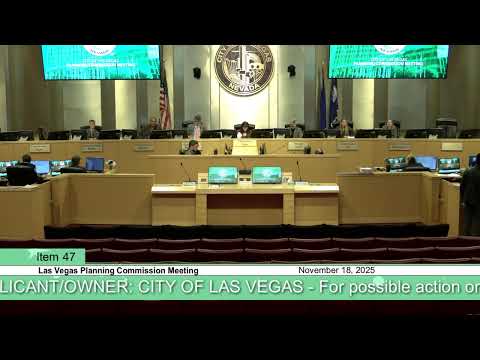
The Planning Commission approved adding a supplemental heat‑mitigation urban forestry element to the Las Vegas 2050 master plan, a package that includes a smart tree inventory and a 25‑year goal to plant 60,000 trees; the item will go to City Council Dec. 17.
The Las Vegas Planning Commission voted to approve a supplemental urban‑forestry and heat‑mitigation element to the city’s Las Vegas 2050 master plan, a framework officials say will guide tree planting, species choices and local heat‑island reduction strategies over the next 25 years.
Marco Velotta of the Department of Community Development presented the proposal and described its long‑range goal: “our long term outcomes are to plant 60,000 trees over the next 25 years on both public and private property,” he said. Velotta said the element will be added to the conservation piece of the master plan and is intended in part to satisfy provisions in AB 96 concerning local heat‑mitigation planning.
Brad Dassler, the city’s urban forester, detailed a new “smart tree” inventory that used lidar and remote sensing to create a digital inventory of municipal trees and canopy coverage. Dassler said the inventory provides a baseline for tracking tree condition, species diversity and canopy changes over time, and will help staff and contractors choose drought‑adapted species appropriate for the Mojave environment.
Commissioners raised operational and equity concerns. Commissioner Chapman asked whether staffing and irrigation oversight would be dedicated to maintain newly planted trees; staff said downtown maintenance crews and a mix of city crews and contractors currently manage public trees and that the plan recommends changes to Title 13 to enable stronger protections and enforcement. Commissioner LeBeau pressed for tighter species controls where municipal and development agreements continue to allow overuse of pines and ash, which the presentation flagged as vulnerable in the city’s climate. City staff acknowledged nursery availability and market practices will make species transitions gradual.
Velotta said the plan lays out estimated costs, roles for Parks & Recreation and code amendments to Titles 13 and 19 to protect and expand canopy. He also announced a USDA grant, awarded through the Inflation Reduction Act, to support free front‑yard tree giveaways in targeted wards and contracted outreach to help residents request trees.
After questions and a brief public comment period with no speakers on the item, Chair Taylor moved approval of the amendment. The motion carried; staff said the item will go to City Council on Dec. 17 for final consideration.
What’s next: The commission’s approval advances the supplemental element to City Council; staff will return with proposed text amendments to municipal code (Titles 13 and 19) and will implement semi‑annual inventories to monitor canopy change and maintenance needs.