Colorado River District offers Shoshone water rights to CWCB; board debates co‑management and emergency exceptions
Loading...
Summary
The Colorado River Water Conservation District has offered to donate perpetual interests in the junior and senior Shoshone hydroelectric water rights to the Colorado Water Conservation Board (CWCB) for permanent in‑stream flow protection. Board members and dozens of stakeholders spent the meeting debating a draft interim flow agreement that creates a co‑management process and narrowly defined emergency exceptions for call reductions.
The Colorado Water Conservation Board spent a large portion of its November session considering a proposed interim flow (ISF) agreement under which the Colorado River Water Conservation District would donate perpetual interests in the Shoshone hydroelectric water rights for use as in‑stream flows on the Colorado River.
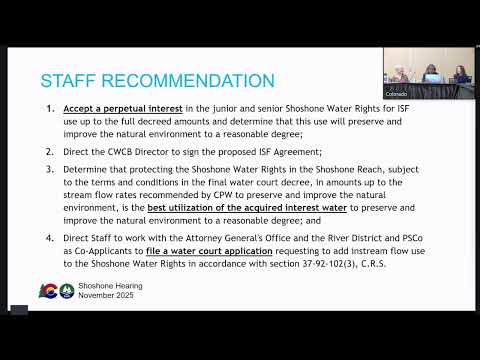
Board staff presented a redrafted agreement intended to respond to four directives the board issued at a prior hearing: clarify how external agreements would be acknowledged, set responsibility for measurement infrastructure, outline how CWCB staff would provide objective technical input in any change‑of‑use water‑court process, and define who could request administration changes and how those requests would be decided.
Why it matters: The Shoshone rights are among the most senior on the Colorado River and help pull water through the system in ways that benefit users and ecosystems downstream. Donating the rights to public stewardship would lock in protection for the middle Colorado River corridor, but it also raises governance questions: who should have final authority to reduce a Shoshone call in extreme drought or crisis — the CWCB, which state law authorizes to appropriate and administer ISF rights, or a joint CWCB–River District co‑management body?
The River District and many Western Slope local governments argued co‑management is essential to win the donation and preserve return flows that sustain farms and communities. "This opportunity exists because of exceptional collaboration," Representative Julie McCluskey told the board, urging acceptance of the staff recommendation to move the proposal to water court. The River District's general manager, Andy Mueller, said the draft agreement preserves a mandatory, narrowly defined call‑relaxation that mirrors a 2007 agreement while creating a multi‑stakeholder, collaborative process for other, rarer reductions.
Front‑range water providers — Denver Water, Northern Water, Aurora and Colorado Springs — supported the acquisition's environmental goals but opposed provisions that, in their view, would permanently cede CWCB's decisionmaking authority. They proposed an alternative: a collaborative review that would be elevated to the CWCB if staff and River District staff could not agree, with the board retaining the final say. "Your decision today carries generational weight," Representative McCluskey said in public comment; front‑range counsel warned that statutory duty requires the CWCB remain the ultimate arbiter.
After mediated talks and multiple redlines, CWCB staff and River District counsel reported agreement on much of the language. The River District agreed to remove several requested factors from the volunteer call‑reduction checklist and accept a narrower set of considerations plus a catch‑all, while CWCB staff inserted clarifying language that the agreement would not supersede existing third‑party arrangements. Legal counsel for the parties confirmed the revised text would be the version filed in water court if the board authorized staff and the River District to co‑apply.
What happened next: The board closed the administrative record and began deliberations on the two statutory findings the CWCB must make: that (1) the acquisition is appropriate to preserve or improve the natural environment to a reasonable degree, and (2) the proposed use will preserve and improve the natural environment to a reasonable degree. Directors publicly explained why the record supports both findings and directed staff to file the ISF change‑of‑use application in water court, subject to final conforming edits to the agreed document. Several directors emphasized continued negotiation in water court and reiterated that the water‑court process will quantify historic consumptive use and the terms governing administration.
What this does not yet do: The water‑court change remains to be decided; the agreement on the boardroom redline is a procedural step that lets the CWCB and River District co‑file and seek a decree to add ISF use to the Shoshone rights. The court will make the legal findings that fix the precise scope of the ISF rates and any terms and conditions necessary to avoid material injury to other water rights.
Looking ahead: Parties agreed to continue mediated discussions and to use the water‑court process for technical quantification and final terms. The board and staff also pledged to work with stakeholders during the court process to resolve outstanding concerns. The hearing record and redlined agreement will be part of the forthcoming water‑court filing.