Get Full Government Meeting Transcripts, Videos, & Alerts Forever!
Get email alerts on the Personal Electronic Devices topic
No spam. Unsubscribe anytime.
Centennial board reviews first read of strict personal electronic device policy after large community survey
Summary
Board members reviewed a first reading of a district policy that would prohibit student use of personal electronic devices during instructional hours, following surveys showing safety concerns and broad student participation; the policy leaves exemptions, appeals and some enforcement details to administrative rules.
The Centennial School District board heard a first reading of a proposed policy that would prohibit student use of personal electronic devices during instructional hours and require devices to be stored in lockers or backpacks rather than on students' persons.
Director Olsen presented results from district surveys — 108 staff responses, 312 parent/guardian responses and 1,623 student responses — saying safety and emergency-access concerns were the most frequent theme and that “passing time and lunch are included in the executive order” and “we cannot make exceptions for those times.” The presenter said clearer communications about emergency protocols and medical exceptions will be added as the policy is finalized.
Board members pressed staff on how the policy would treat off-campus lunch passes and Individualized Education Program (IEP) accommodations. A district representative noted that IEPs must be reviewed annually and that accommodations are reconsidered at the IEP review meeting. On enforcement, staff described a restorative practice used in some buildings: phones may be returned pending a scheduled family meeting designed to problem-solve rather than solely to punish.
Principal Miller told the board that enforcing the policy consistently is an implementation priority and that storage choices (classroom storage, lockers or backpacks) should be clarified for K–12 settings to avoid uneven application between schools.
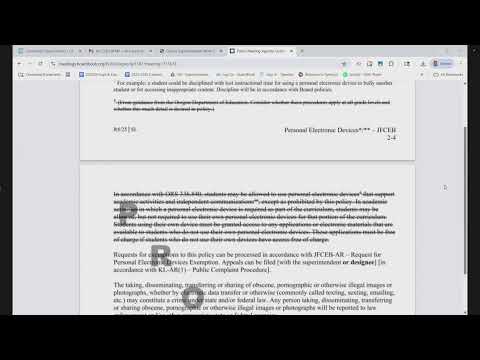
Director Olson outlined key policy language during the first read: exemptions for medically necessary or instructional uses will remain, appeals will be filed with the superintendent or designee, and the AR will contain the procedural details (including exemption forms and timelines). The board discussed striking permissive language that would have allowed staff discretion to permit phone use during classroom activities; staff said the change was made in part to avoid equity problems when a classroom activity requires technology that the district must supply to ensure all students can participate.
The policy remains at first read and will return to the board for a second reading and possible adoption. Staff said earlier that the policy must be in place to comply with a governor’s executive order that sets a district deadline for adoption and a planned effective date of Jan. 1.