Get Full Government Meeting Transcripts, Videos, & Alerts Forever!
Get email alerts on the Environmental Regulations Project topic
No spam. Unsubscribe anytime.
Charlottesville planning commissioners review environmental regulations project; staff seek guidance on stormwater, tree canopy and floodplain rules
Summary
City planning staff presented a two‑year project to review environmental regulations — stormwater, floodplain management, tree canopy, stream buffers, critical slopes and energy/EV planning — and asked commissioners for priorities and phasing; commissioners pressed staff on drought planning, stormwater credits and maintenance, and utility capacity data.
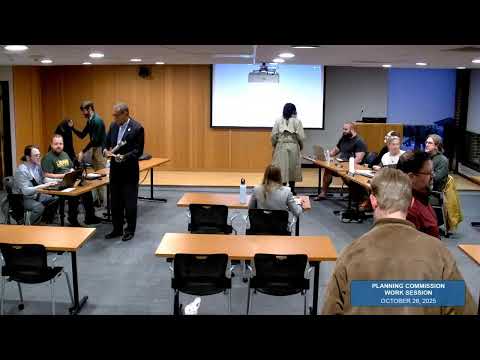
City planning staff on Wednesday outlined a comprehensive review of the city’s environmental regulations aimed at aligning land‑use rules with the comprehensive plan, climate goals and recent technical studies.
"We're looking for your feedback and then also council's direction on the proposed phasing of project topics," said Tori Kanalopoulos, principal planner on the long‑range planning team, who opened the work session and walked commissioners through project objectives, related plans and six topic areas. Staff described the effort as roughly a two‑year project and said they will present project goals and commissioner input at a City Council work session scheduled for Nov. 17.
Why it matters: staff framed the review as an effort to balance housing choice and affordability with protection of natural and built environments, improve community resilience to hazards such as flooding and extreme heat, and make regulation and implementation more equitable. Potential outcomes include targeted updates to the development code, the comprehensive plan, and city programs and guidance.
Key topics covered: staff summarized planned analysis and questions for commissioners on stormwater management (especially how small infill lots meet on‑site detention and the local value of off‑site nutrient credits), floodplain management (the city currently meets FEMA’s minimum National Flood Insurance Program standards but can consider adopting higher thresholds), tree canopy and street tree preservation (noting neighborhood variation in canopy), stream buffer protections, critical slopes (defined in the presentation as 25% grade, minimum 6,000 sq ft and within 200 feet of a waterway) and energy/EV planning.
On stormwater, Brennan Duncan, city engineer, clarified how the city administers statewide stormwater rules and the limits on what the locality can require. "Developers are able to buy the off‑site credits to meet water‑quality requirements, which benefits larger watersheds, but they're still required to meet quantity/detention requirements on‑site," Duncan said, adding that an on‑site stormwater facility can cost tens of thousands of dollars while buying credits can be far less expensive in many cases.
John Schrager, stormwater utility administrator, described an ongoing stormwater model and a capacity study that will allow staff to test different rainfall and impervious‑surface scenarios for long‑range planning; that modeling remains in progress and staff expect to complete it in a few months.
Commissioners’ priorities and questions: during discussion commissioners urged staff to add drought mitigation and resilience to the scope, to pursue regional coordination (including with UVA and county partners), to consider quick, high‑value capital fixes and to make more technical data available to developers (for example, hydrant locations and fire‑flow test results). One commissioner asked staff to consider whether the city can or should pursue self‑insurance or other approaches instead of full reliance on the National Flood Insurance Program; staff said those are among the policy options they will examine during baseline assessment work.
Maintenance and capacity: commissioners and staff flagged maintenance shortfalls for Best Management Practices (BMPs) and other stormwater infrastructure. Staff said the city plans a multiyear inventory and assessment to document existing BMPs, estimate costs to bring them up to standard and evaluate staffing and contracting options to maintain them.
Next steps: staff will use commissioner feedback to refine phasing and scope, establish internal stakeholder groups and technical committees, and develop a public engagement plan and project website where the community can sign up for updates. Staff will present the refined plan at a council work session on Nov. 17.
No formal regulatory changes or votes were taken at the work session; commissioners provided direction and requested follow‑up information. A short procedural motion to adjourn was made and seconded at the end of the meeting; no roll‑call vote is recorded in the transcript.