Get Full Government Meeting Transcripts, Videos, & Alerts Forever!
Get email alerts on the Energy Infrastructure topic
No spam. Unsubscribe anytime.
Public Service Commission warns of rapid data-center demand that could require tens of billions in new generation and transmission
Summary
The Public Service Commission told the Appropriations subcommittee that recent data-center contracts have multiplied Georgia Power's near-term demand forecast from hundreds of megawatts to nearly 10,000 MW, a shift that could require approximately $30 billion in generation and transmission investments.
The Public Service Commission told the Appropriations Subcommittee that an unprecedented wave of data-center load is driving a rapid escalation in the state's electricity needs and could substantially increase regulatory oversight and agency workload.
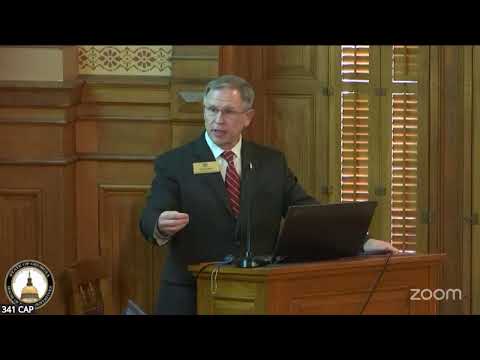
Reese McAllister, executive director of the Georgia Public Service Commission, and Tom Bond, director of utilities, briefed the committee on FY25 and FY26 appropriations the commission has received for pipeline safety inspectors, attorney fees in a FERC matter, and recruitment/retention allowances. They warned those appropriations come as the commission confronts dramatically higher demand forecasts tied to large data-center customers.
Bond summarized the change in Georgia Power's forecasts: "Just 3 years ago in 2022... they said they needed 400 new megawatts over the next 7 years. Then just 1 year later in 2023... they said they needed 6,600 megawatts. And now they estimate 9,900 megawatts," driven primarily by data centers. He told the committee large data-center customers are often in excess of 100 MW and sometimes over 1,000 MW; by contrast, Georgia's current peak load is roughly 16,200 MW.
Why it matters: adding nearly 10,000 MW would be an increase of more than 50% of present peak demand and imply roughly $20 billion to build new generation plus about $10 billion in transmission upgrades, Bond said. The PSC is conducting hearings to determine what generation the commission will certify and will continue construction monitoring to ensure costs and schedules remain prudent.
The commission has already adjusted rules for contracting with very large customers and is reviewing more than 4,400 MW in new contracts received between 2023 and 2024, plus another 1,900 MW executed under revised rules in 2025. Bond told legislators the PSC could require additional staff and resources to provide thorough construction monitoring and to manage the administrative workload as projects come forward.
Committee members asked about the commission's staffing needs; Bond said a final determination depends on the commission's certification decisions later this year but noted the PSC previously disallowed $5 billion of Plant Vogtle spending during review, underscoring the value of active oversight.
Next steps: the PSC expects to issue decisions in late December in ongoing certification hearings; the commission will return to the legislature if staffing or funding needs change materially.