Get Full Government Meeting Transcripts, Videos, & Alerts Forever!
Get email alerts on the Habitat Restoration topic
No spam. Unsubscribe anytime.
Clark County uses Spud Mountain thinning to supply engineered habitat for East Fork Lewis River reconnection
Summary
Clark County transferred more than 700 logs from a recent Spud Mountain thinning to a Lower Columbia Estuary Partnership river-reconnection project that aims to install over 5,000 logs, fill eight former gravel pits and restore habitat; work is expected to finish by October 2026 and the river is closed to recreation for three miles downstream of Daybreak Regional Park.
Clark County officials and project partners said this summer’s selective thinning at Spud Mountain supplied more than 700 logs to an ongoing river-reconnection project on the East Fork Lewis River, part of a larger effort to restore floodplain habitat and reduce wildfire risk.
County presenters said the thinning was undertaken after an earlier inventory recommended cutting in the 8–10 year window. "Selective thinning allows the remaining trees to receive more resources such as sunlight and water and reduces fuel loading and wildfire risk," Speaker 1 said, summing up the forest-health rationale.
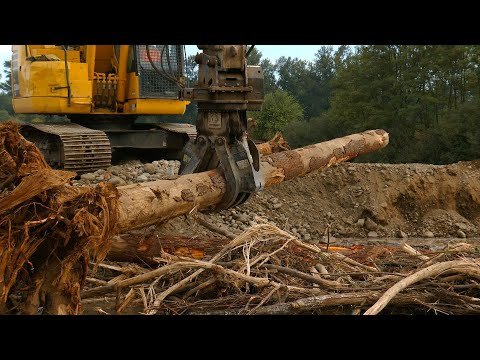
The logs have several uses. Some were sent to be milled for dimensional lumber or made into utility poles, while a reserved set of large trees — more than 700 from Clark County’s Spud Mountain property — were transferred to the reconnection project to create in-stream and bank habitat, Speaker 1 said. "We designed the habitat structures to look as natural and function as naturally as possible, but they're also highly engineered to ensure that they stay on-site and they don't float downstream," Speaker 4 said.
Project managers from the Lower Columbia Estuary Partnership, identified in the presentation as the designer and manager of the reconnection work, and county staff said the restoration includes removing levees and berms, recreating side channels and placing wood to slow water, spread flows across the floodplain and provide cover for salmon, steelhead and lamprey. Speaker 4 said the project intends to install more than 5,000 logs "to slow the water down and they spread it out across the flood plain" and to create pools and hiding places for juveniles and adults.
During the first construction window crews filled five of eight gravel pits, the presenters said. Officials described next steps: return next year to dewater the three remaining pits, rescue fish before work in those pits, complete construction and "wrap things up by October," Speaker 4 said; presenters specified the project completion as fall 2026. Until the project is complete, Speaker 1 said, "the river remains closed to boaters and other recreationists for 3 miles downstream of Daybreak Regional Park."
Presenters also discussed ecological benefits of in-place wood: logs capture leaves and organic material that support aquatic insects and broader food chains. In addition to the county’s contribution of more than 700 logs, Speaker 1 said the remainder of the wood comes from other local sustainably managed forests and trees removed during construction.
The presenters described 13 types of engineered habitat structures, anchored either by burying them in the bank or by attaching them to vertical piles so they remain on site. They said revegetation is planned for the rainy season, with tens of thousands of native plants to be installed and volunteer opportunities posted at estuarypartnership.org/volunteer.
No formal votes or policy approvals were recorded in the presentation. The county and the Lower Columbia Estuary Partnership characterized the work as ongoing construction and restoration through fall 2026.