Get Full Government Meeting Transcripts, Videos, & Alerts Forever!
Get email alerts on the Water System topic
No spam. Unsubscribe anytime.
Greene County rejects high bids for chlorine conversion project, opts to rebid
Summary
After low bids for a project to convert well sites from gas to liquid chlorine came in roughly $1.38 million over budget, commissioners voted to reject the bids and re-advertise, with staff to consider reducing scope or seeking alternate funding.
Commissioners voted to reject the low bids for a county project to convert multiple well sites from gas chlorine to liquid chlorine after the bids exceeded the available budget by about $1.38 million.
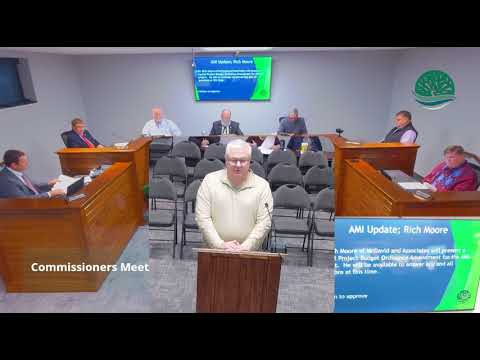
Mister Moore outlined the project and said the county sought to remove gas chlorine systems at well sites for safety reasons and switch to a liquid feed system. He told the board the project had been put to bid three times, and the lowest responsive bid nonetheless exceeded the budget by "over 1,000,000 dollars." Moore presented four options: request supplemental funds from the state (which he said would likely be loan rather than grant), use $1 million from the county’s alternate water supply fund to proceed, reduce project scope (for example removing wells 3, 4 and 7 from the initial work), or reject the bids and rebid. "Based on how high this bid is, would be to reject the bid and re-advertise the project," Moore said, and he recommended rebidding to seek more competitive pricing.
After discussion about contractor roles, conversion methods and safety rationale — Moore explained liquid systems use large drum tanks and chemical feed rather than gas and said two well sites already operate on liquid — the board moved and approved a motion to reject the bids and re-advertise the project by voice vote.
What happens next: Staff will prepare a rebid package and may explore options to reduce scope or seek alternative funding sources; commissioners discussed the possibility of cutting wells from the initial project to match available funds but gave staff authority to return with options rather than committing local loan funds at the meeting.