Get Full Government Meeting Transcripts, Videos, & Alerts Forever!
Get email alerts on the School Budget topic
No spam. Unsubscribe anytime.
Surprise state aid and cyber-charter costs leave Dover Area SD with higher revenue and harder questions for board
Summary
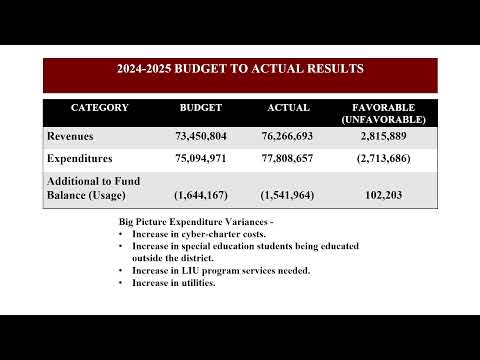
At a board meeting, Mrs. Weaver presented the district—s 2024—25 financial results: the district used about $100,000 less fund balance than planned and closed the year with roughly $15 million, but unplanned cyber-charter and special-education costs increased expenditures by about $2.7—2.8 million and prompted board members to press staff on budget authority and program costs.
Mrs. Weaver, the presenter identified at the meeting, told the Dover Area SD board that the district used roughly $100,000 less of its fund balance than projected when the 2024—25 budget was adopted and that the district—s fund balance stood at about $15 million as of June 30.
The district received more revenue than expected, Mrs. Weaver said, including roughly $251,000 of additional local receipts, about $1.3 million more in state aid after the state budget was enacted post-adoption, and roughly $1.3 million of federal or other revenue (largely remaining ESSER funds and delayed equipment receipts). —We received about $251,000 more than we anticipated,— Mrs. Weaver said, and she listed additional basic subsidy, special-education subsidy, transportation and debt-reimbursement increases and a Ready-to-Learn grant as major contributors.
Why it matters: the additional revenue offset higher-than-expected spending, but board members said the size and unpredictability of some costs raise governance questions. A board member said, —it almost seems like there—s a futility to the whole budgeting process— when large, mandatory costs arrive after budgets are set. Another board member pressed staff on how the district could exceed budgeted expenditures by roughly $2.7—2.8 million without supplemental board authorization.
Board members and staff singled out cyber-charter tuition and special-education placements as the largest unplanned drivers of higher spending. Mrs. Weaver reported that about 40 students attended outside cyber programs this year, producing roughly $840,000—$900,000 in additional tuition costs the district had not budgeted. Board members asked whether Dover—s in-house cyber program (about 50 students) offsets that outflow; staff said in-house placement costs roughly $3,000 per student plus teacher costs but that some students transfer to outside cyber providers when they do not complete work in the district—s program.
On school resource officers (SROs), a board member said an earlier slide looked misleading; Mrs. Weaver explained the district made a one-time catch-up payment for a service period whose timing shifted across fiscal years and that going forward the district will align expense recognition with service periods so the timing distortion will not repeat.
Accounting and process notes: staff emphasized that timing and accounting standards can create budget variances without changing the bottom-line fund balance. Mrs. Weaver explained that some ESSER and equipment receipts were budgeted in 2023—24 but recognized in 2024—25 because of construction and delivery timing; she also cited GASB accounting practices and school-code rules as the mechanism that permits expenditures to be paid from fund balance when actual costs exceed budgeted figures.
A senior board member said the board—s role in approving budgets still matters for decisions staff can control (for example, buying a math program), but conceded many costs (special-education placements, students moving into the district, cyber-charter tuition mandated by choice) are outside local control. A district staff member stressed the practical limit: —We have to educate anybody who comes through our doors,— and said unfunded state mandates and mandated services constrain local discretion.
The meeting did not yield any formal motions or votes on budget changes; staff offered to supply a follow-up calculation on the net fiscal effect of the district—s in-house cyber program versus outside cyber-charter costs and to provide additional details about expected SRO contract increases.
The board—s next steps: staff will provide requested calculations and clarifications; no formal supplemental appropriation or vote was recorded during the presentation.