Get Full Government Meeting Transcripts, Videos, & Alerts Forever!
Get email alerts on the Pedestrian Safety topic
No spam. Unsubscribe anytime.
Greenville updates pedestrian safety action plan and Traffic Management Center capabilities
Summary
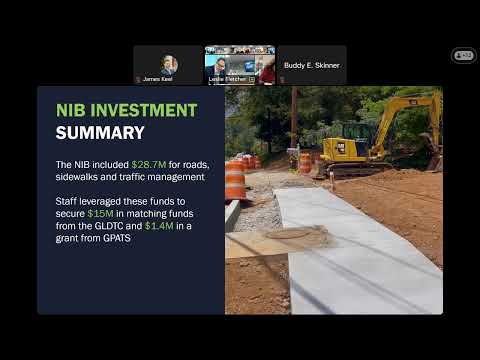
City staff reported implementation of Phase 1–2 pedestrian safety measures in school zones and corridors (roughly 650 ADA ramps, ~680 crosswalks, rapid-flashing beacons), and described Traffic Management Center equipment and testing of emergency-vehicle preemption.
City engineers and traffic staff briefed the mayor and council on the Pedestrian Safety Action Plan and Traffic Management Center (TMC), describing recent installations and next steps.
Valerie, an engineering presenter, said the TMC opened Sept. 3 and listed field equipment paid for with NIB funds, including roughly 117 Bluetooth devices, about 60 video monitoring cameras, 160 battery-backup systems and approximately 210 emergency-vehicle preemption units. "We have about 60 to 61 video monitoring detection… we did buy all 160 battery backup systems with our new funding plus our 210 emergency vehicle preemption systems," she said.
Staff said cabinet testing and pre-deployment checks for the preemption units were underway with a target to enable vehicle-based preemption in the first quarter of next year. Engineers noted some intersections need cabinet upgrades because current cabinets are too small to accept backup systems, and they identified those cabinets as a near-term upgrade priority.
On pedestrian safety, engineering staff summarized Phase 1 and Phase 2 work: they said every school zone and major corridor was addressed and the work included about 650 new curb ramps and roughly 680 new crosswalks, plus added rapid-flashing beacons at prioritized locations, including a push-button beacon at Washington and Irvine. Presenters showed drone footage of Washington/Irvine and Unity Park crosswalks and described an added railing on Mills Avenue after a fall reported near a slope.
A council member praised the TMC and suggested more public outreach so residents understand the system’s capabilities; staff agreed to continue community communication and to follow up on aesthetic questions such as decorative crosswalks.