Get Full Government Meeting Transcripts, Videos, & Alerts Forever!
Get email alerts on the Audit Prioritization topic
No spam. Unsubscribe anytime.
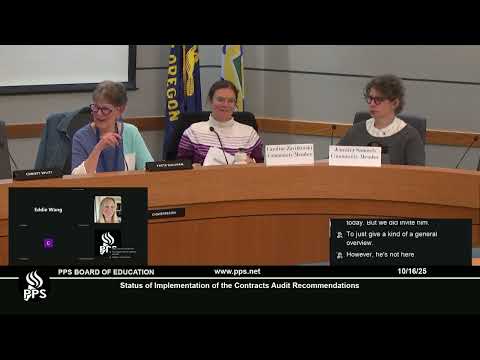
PPS audit committee narrows 2025–26 performance‑audit priorities to substitutes, principal support and student measures
Summary
At its latest meeting, the Portland Public Schools Audit Committee narrowed a list of proposed performance audits to three priorities: substitute/teacher‑absence protocols, principal support systems, and a series of student‑performance audits tied to board goals. Staff will build proposals for the committee to choose two in November.
The Portland Public Schools (PPS) Audit Committee narrowed a slate of proposed performance‑audit topics and asked staff to prepare detailed proposals on the top choices for a November decision.
Chair Patty Sullivan opened the meeting and said the committee would focus this year on ensuring the internal performance audit work aligns with board goals and delivers actionable recommendations. Janice Hanson, the district’s internal auditor, presented the audit work plan and a menu of suggested topics.
Committee members gave strongest support to three topics: an audit of teacher absences and substitute‑teacher protocols, a review of support systems for principals, and a series of audits of student‑performance measures tied to specific board goals. Hanson said the committee should avoid scope creep on the student‑performance topic by treating it as a multi‑year series rather than a single, all‑encompassing review.
Several members explained why the substitute/protocol topic was urgent. “It is more like how do we adapt to a world in which a career path that is predominantly women … has broader paid‑leave protections,” said Christie (school board member, Zone 1), arguing the audit should examine operational responses rather than employees’ entitlement to leave. Hanson cautioned about message and scope: “We want to make clear that the audit is not an attempt at restricting legally protected leave,” and said the audit would follow generally accepted government audit standards (GAGAS).
Members suggested practical areas the substitute audit could cover: district‑level policies for filling absences, building‑level substitute procedures, strategies other districts use (including retention or in‑building floater roles), and ways to better prepare substitutes for instruction.
On principal support, Hanson noted PPS’s multi‑year work funded by a Wallace Foundation grant to build an equity‑centered principal pipeline and proposed auditing how that investment has affected recruitment, training and retention. On student measures, members favored breaking the work into focused audits, each aligned with a board goal, to provide timely, actionable findings.
The committee conducted an informal poll of members to identify favorites. Hanson will prepare scope documents and cost/time estimates; the committee expects to choose two topics to refer to the full board for approval at its November meeting.
Next steps: Hanson will develop formal proposals with objectives, ties to board goals, and estimated timelines. The audit committee will review those proposals at its November meeting, where members will select which audits move forward for board approval.