Get Full Government Meeting Transcripts, Videos, & Alerts Forever!
Get email alerts on the Vision Zero topic
No spam. Unsubscribe anytime.
Orange County pushes Vision Zero plan to cut roadway deaths, seeks grants and local funding
Summary
County staff presented the recently adopted Vision Zero (Vision 0) action plan with a goal to eliminate fatalities and severe injuries by 2040, outlined a 50‑item countermeasure toolkit and said the county is pursuing federal grants and using local Accelerated Transportation Safety Program funds to begin short‑term projects.
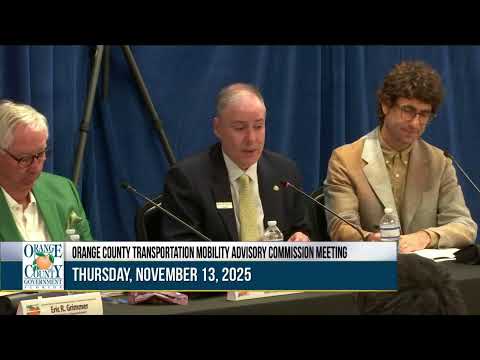
County transportation staff on Nov. 13 outlined a newly adopted Vision Zero action plan that sets an aspirational countywide goal of eliminating traffic fatalities and severe injuries by 2040 and ties that target to a set of prioritized safety countermeasures and funding strategies.
Humberto Castellaro, who led the TransMAC presentation, said the plan is data driven and regionally coordinated, drawing on five years of Florida Department of Transportation crash data and regionwide planning through MetroPlan. "The purpose for us is to eliminate fatalities and severe injuries by the year 2040," Castellaro said. He added, "We will not accept anything but 0," describing that target as both ambitious and urgent.
Why it matters: Castellaro told commissioners that vulnerable road users — pedestrians, bicyclists and motorcyclists — make up a large share of local fatalities, and that county crash mapping and a 24‑corridor high‑injury network identify where short‑term countermeasures can be directed. He said the county used five years of FDOT crash data (2018–2022) for the analysis and that the county will track before‑and‑after results to measure progress.
Funding and tools: Castellaro said MetroPlan regional work helped secure a Safe Streets for All grant pool, with MetroPlan receiving $3,700,000 and Orange County receiving $400,000 to develop the Vision Zero action plan. The county later applied for a separate federal Safe Streets for All grant seeking $25,000,000 with a 20% local match. Castellaro also described a mayor‑led Accelerated Transportation Safety Program (ATSP), which he said was seeded with $100,000,000 to accelerate short‑term safety projects, and a $15,000,000 safety initiative spread over three years for speed management and other countermeasures.
Priorities and countermeasures: The plan includes a public‑facing toolkit of about 50 safety countermeasures, with each "safety card" noting crash‑reduction effectiveness, expected implementation timeframe and rough cost indicators to help staff and residents compare options. Castellaro highlighted low‑cost, short‑term measures (speed feedback signs, enhanced crosswalks, intersection lighting) and costlier retrofits such as corridor reconstructions and roundabouts, including a lower‑cost prefabricated roundabout pilot in Wyndham Lakes.
Enforcement and legal limits: Presenters and commissioners discussed the limits of local authority. Castellaro said the county has an ordinance to implement automated speed enforcement in school zones, and staff are preparing an RFP; the rollout will start with an initial set of schools. He also noted that broader mid‑block automated speed enforcement requires state legislative changes and that the county is discussing options with legal counsel. "Engineering alone isn’t enough," Castellaro said, stressing the role of the Orange County Sheriff’s Office, education campaigns and emergency‑response coordination.
Commission reaction: Commissioners and members asked whether Vision Zero could enable community‑level enforcement or paid neighborhood safety monitors; staff said the idea merits legal review. Members also pressed staff on how short‑term, cost‑effective countermeasures will be prioritized in the CIP and how the county will demonstrate measurable progress every five years.
What’s next: Castellaro said staff will return with funding proposals and CIP alignment; the county awaits federal grant awards and will continue short‑term implementations where budgets and partnerships allow. The commission will continue to review progress and may recommend funding or policy changes to the Board of County Commissioners.
Sources: Presentation and Q&A with Humberto Castellaro and TransMAC members during the Nov. 13 TransMAC meeting at Barnett Park. Direct quotes in this story are taken from Castellaro’s presentation to the commission.