Get Full Government Meeting Transcripts, Videos, & Alerts Forever!
Get email alerts on the Broadband topic
No spam. Unsubscribe anytime.
St. Tammany uses ARPA funds to accelerate rural broadband; 3,000 homes targeted
Summary
Parish IT staff described an ARPA-funded last-mile grant strategy that aims to connect roughly 3,000 households by paying per-house connections and leveraging private ISPs; staff said the parish stretched about $7 million to address what they characterized as a roughly $72 million network gap.
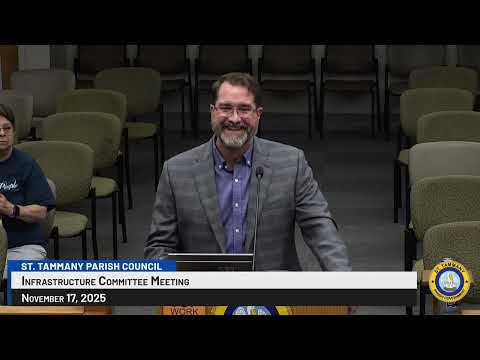
St. Tammany Parish officials on Tuesday described a phased broadband rollout that uses American Rescue Plan Act (ARPA) funds to fill persistent rural coverage gaps. Technology Director Grant told the Infrastructure Committee the parish purchased speed-test data and identified a rural “shadow” area that represented about a $72 million build problem. The parish had about $7 million available and adopted a last-mile grant approach to stretch that funding.
Grant said the parish divided the area into seven “fiberhoods” and offered per-house connection payments so private internet service providers would build the middle mile and serve the neighborhoods. “We were able to solve the $72,000,000 problem for $7,000,000,” Grant said, describing the strategy as intentionally focused on paying to reach specific houses so providers would complete the rest of the connection.
The phased procurement awarded contracts to multiple providers. Grant said AT&T and the SWIFT provider participated in pilot areas and that Folsom has the first connected household. He described 24-month contracts for buildout and said phase two includes Waldheim and Lacombe, with additional eastern areas to follow.
Grant told the committee the parish paid for about 3,000 homes at roughly $2,800 per home and said that leveraging typically extends the reach (he cited 400 paid connections in Folsom resulting in about 1,200 households ultimately obtaining service). He contrasted the parish per-house cost to a state-run “gumbo” grant, which he said ran about $7,900 per home.
When asked about state and federal funding, Grant said remaining unserved gaps are expected to be filled through BEAD and other state programs but that BEAD funding was “being held up” at the federal level; he gave different timeline references in discussion (one target mentioned was December 2026, another December 2029) and offered to provide precise parishwide percentages later. He estimated the current project footprint addresses about 15–20% of the previously uncovered area and noted municipalities were excluded from the study.
Grant also described a new 10-gigabit parish backbone that, he said, enables providers inside the project footprint to offer up to 5 Gbps symmetrical service to individual addresses. President Cooper asked whether schools, libraries and businesses on the periphery would benefit; Grant said some are already switching from charter or cable services to the new fiber service.
The committee heard no formal votes on the broadband item because the clerk announced a lack of quorum at the start of the meeting; members proceeded with presentations by unanimous consent. The parish said it will supply additional coverage percentages and timeline details as they become available.