
Senate panel debates using $104 million in ARPA funds for Manila utilities; court fight over GURA complicates vote
Get AI-powered insights, summaries, and transcripts
Subscribe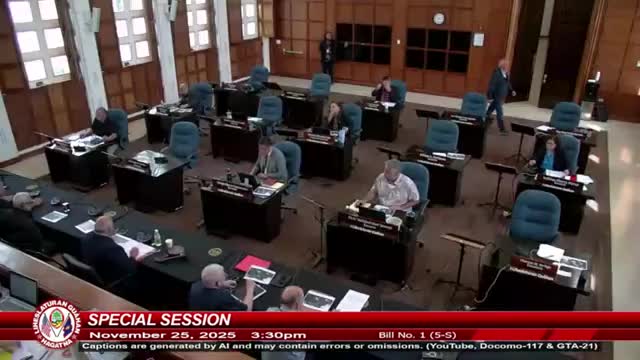
Summary
Lawmakers spent hours probing whether $104 million in ARPA money obligated for Manila infrastructure can be spent without federal clawback, amid a court ruling limiting GURA's eminent‑domain powers and the attorney general's refusal to review procurement packages. Senators split over urgency versus legal risk.
Senators spent most of a day questioning agency officials and lawyers about Bill 15‑S, which would authorize installation of utilities infrastructure on Lot 5280‑3 in Manila using about $104 million in American Rescue Plan Act funds.
The bill centers on whether the money was properly “obligated” to the Manila project before the Treasury’s 2024 deadline and whether the Legislature can move forward while a separate court case and the Attorney General’s refusal to review procurement materials remain unresolved. Senator Parkinson framed the choice starkly: “This is a yes, a $104,000,000 or no, $0.”
Why it matters: Treasury rules require written justification for capital projects of $10 million or more and tightly restrict reprogramming after the obligation deadline. Panel lawyers told senators the Treasury received a written justification when the project was first conceived and that interagency agreements were used to obligate funds before 12/31/2024. But senators pressed for the actual Treasury submission, the interagency MOA and solicitation packages so legislators could verify compliance and the risk of federal clawback.
Panel testimony and agency estimates: Agency representatives and procurement counsel outlined the project budget for utilities and related work — roughly $35 million for power, $26 million for water, $36 million for wastewater, $1 million administrative fee and about $5.5 million for civil engineering (total roughly $104.8 million). Officials said a phase‑1 solicitation package had been submitted to the Attorney General’s office but not advertised; the AG has publicly declined to review certain packages.
Legal complications: Senators repeatedly cited a recent court ruling that limited GURA’s eminent‑domain authority, and asked whether the loan, acquisitions and the development plan included housing components before the obligation date. GURA officials said housing was intended as part of a broader community‑development approach but acknowledged formal housing plans were developed after some acquisitions, a point several senators highlighted as legally significant. Ranking members warned that intervening in a litigated matter risks conflicting with the judiciary and could expose the government to repayment obligations.
Procurement safeguards and 51‑50 review: The bill would change who performs the 51‑50 procurement legality review rather than eliminating review, panel counsel said; utilities traditionally used either in‑house counsel designated as special assistant attorneys general or GSA procurement counsel for those checks. Several senators sought explicit reporting and monitoring commitments if any statutory safeguards are relaxed.
Vote and procedure: After extended debate and several procedural motions, the House took a roll call on final processing. The record shows a roll call tally of 2 yays, 10 nays and 3 excused during the third‑reading sequence. The record also shows committee and floor motions and objections on whether to proceed to third reading without engrossment; the transcript records multiple procedural votes and objections before the session adjourned.
What’s next: Senators who urged caution said they need direct access to the Treasury submission, interagency MOAs, GWA/GPA project plans and the procurement solicitation packages before deciding how to act. Sponsors and senators urging urgency argued that the December 2026 spending deadline and long lead times for equipment create an operational risk if the Legislature delays. The Legislature adjourned after completing the day’s procedural business; the record does not show the bill enacted into law during this session.
The panel provided contact‑level commitments to make public documents available and continued to stress that federal audit rules and monthly ARPA reporting to the legislature would remain in force; several senators asked for a subsequent session with the missing agency officials present so the body could scrutinizeTreasury submissions, procurement records and the status of pending litigation.