Get Full Government Meeting Transcripts, Videos, & Alerts Forever!
Get email alerts on the Education Report Card topic
No spam. Unsubscribe anytime.
New curriculum supervisor presents Riverside's 2025 state report card; district highlights progress and targets
Summary
Curriculum supervisor Katie Line Webber presented Riverside Local's 2025 state report card and new teacher/principal dashboards, saying the district is at 3.5 stars overall with pockets of 4- and 5-star performance and targeted areas for improvement in progress, early literacy and chronic absenteeism (22.9%).
Katie Line Webber, the district's new curriculum supervisor, walked the Riverside Local Board of Education through the district's 2025 state report card and newly released dashboards, saying the district's overall rating was "pretty close to what it looked like last year, quite honestly" and highlighting both areas of strength and where the district plans to focus improvement efforts.
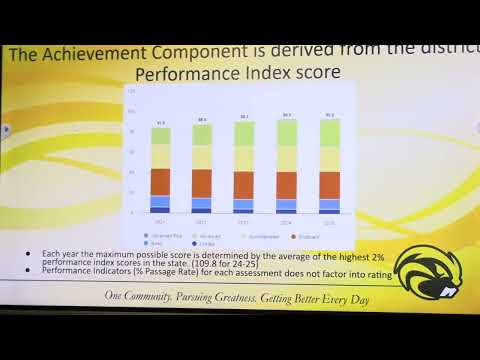
Webber told the board the district earned 3.5 stars overall, with achievement, gap closing and graduation rated at 4 stars and progress rated at 2 stars. She said some schools earned higher marks: "Both Mel Ridge and Riverview at 4, and then Buckeye and Parkside were 4 and a half stars." Webber explained how the performance index and star system are calculated, noting Riverside's performance index was 90.2 this year (82.2% of the state's top benchmark) and that star thresholds are effectively a 90/80/70/60 scale.
Webber and district staff described how the ratings are computed and what they mean at classroom and district levels: achievement and progress carry heavier weights at the district level, and several components (early literacy, college/career readiness, chronic absenteeism) are calculated differently by grade and subgroup. On chronic absenteeism Webber said the district rate was 22.9 percent, above the state's target of 16.4 percent, and that the district is already using a dashboard and targeted interventions to understand causes and reduce absences.
Presenters emphasized data tools and curricular changes intended to drive improvement. Webber and staff described teacher-facing dashboards from the Education Service Center (EFC of Northeast Ohio) that break scores down by standard and released test items, allowing teachers to see exactly which standards and released items need attention. Staff said the district is implementing new ELA and math curricula (Wit & Wisdom for K—2 and CPM for math) and is using MTSS protocols, instructional rounds, personalized learning cohorts and fidelity checks to support teachers and students.
On progress (value added), staff said the measure is a three-year composite using normal curve equivalents and that accelerated students can be excluded from some progress models, which complicates interpretation. Presenters identified specific grade-level concerns in math (fifth, sixth and eighth grades) and noted algebra and American history gains at the secondary level. For early literacy the board heard that the district meets or exceeds third-grade reading proficiency in many measures and uses K— diagnostics and interventions; staff said the district aims to push the diagnostic window later in the fall to reduce summer-slide effects.
Webber outlined college, career, workforce and military readiness measures, saying Riverside earned three stars on that component and stands second in Lake County on the new measure. She noted the metric counts whether a student meets any one of several indicators (AP scores, dual-enrollment credit, industry credentials, OhioMeansJobs readiness seal, enlistment, apprenticeships) and that state data-timing and reporting can delay credit for some items.
Board members asked for granular counts and follow-up data; Webber said the dashboards can provide building- and subgroup-level numbers on request. She also acknowledged that some calculations and reporting timelines are set by the state and that district staff are pursuing better data collection and state advocacy where the rules create unintended effects.
The presentation concluded with a summary of strategies to address low-progress areas: targeted curriculum adoption, improved formative assessments, teacher collaboration (instructional rounds), expanded gifted credentialing, and specific interventions for attendance and early literacy. The board moved on to policy and finance business after the presentation.