Get Full Government Meeting Transcripts, Videos, & Alerts Forever!
Get email alerts on the Court Docket Roundup topic
No spam. Unsubscribe anytime.
Monroe County courtroom processes arraignments, guilty pleas and probation revocations; multiple sentencings set for Dec. 15
Summary
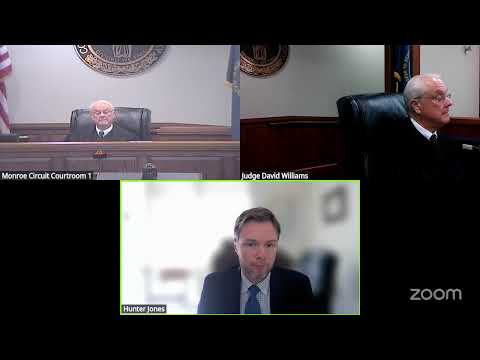
Judge David Williams presided over a full Monroe County docket that included guilty pleas in several felony trafficking and possession cases, probation‑revocation hearings and civil matters; sentencing and negotiation dates were widely scheduled for Dec. 15 and Dec. 5 respectively.
Judge David Williams opened a full Monroe County court docket and handled arraignments, guilty pleas, probation‑revocation hearings and several civil matters. Many criminal cases were resolved by negotiated pleas or by scheduling further proceedings; the court repeatedly set negotiation dates for Dec. 5 and sentencing or follow‑up hearings for Dec. 15.
Among the criminal matters, the Commonwealth presented sentencing recommendations in multiple guilty‑plea cases. For possession of a controlled substance (first degree, methamphetamine), the Commonwealth recommended a 3‑year sentence with five years probated and supervised probation including referral to a social‑service clinician. In two trafficking cases involving fentanyl, the Commonwealth recommended an eight‑year sentence with parole eligibility at 50 percent; the court ordered pre‑sentence investigations and scheduled sentencing arraignments for Dec. 15. The judge told defendants they had the right to withdraw a plea if the court imposed a harsher sentence than anticipated, and repeatedly canvassed defendants on whether pleas were entered voluntarily.
Several probation‑revocation hearings produced mixed outcomes. In the case of Mark Brown, probation officers testified to multiple missed contacts and a home visit that raised concern; Judge Williams found Brown had jail time credited as a sanction but released him from custody with instructions to report to the Glasgow probation officer and maintain employment. In another revocation hearing, officers reported a defendant (Christopher Stillwell) attempted to use an artificial device to supply a urine sample; the contrived sample was discarded and a subsequent legitimate test was positive for methamphetamine. The court placed a hold and scheduled follow‑up.
The court also handled pretrial‑diversion and specialty‑court requests. At least one defendant (Guy Williams) was referred to drug court evaluation rather than having diversion revoked, and the court discussed sober living and treatment placement as alternatives to incarceration in other matters.
On civil and family dockets, the court entered a judgment and order of sale in a tax‑lien case brought by Mid South Capital Partners, and addressed a motion by Vanderbilt Mortgage regarding default judgment and in rem relief; the judge explained that a successful in rem remedy is limited to the property and will not create a personal deficiency judgment beyond the property value. In a family‑law motion (Kepshaw v. Kepshaw) the parties discussed expanded holiday visitation; Judge Williams encouraged mediation and short‑term holiday arrangements while reserving final determination.
The grand jury finished its presentments for the day and was discharged; the judge thanked jurors and set the next grand jury date. At multiple points the bench emphasized scheduling and procedural fairness: “Both of them are conditioned to your bond,” a stock court admonition repeated throughout the docket about negotiation and next‑hearing dates.
Next steps: numerous negotiation days were set for Dec. 5 and many sentencing or follow‑up hearings were scheduled for Dec. 15. Where the Commonwealth recommended prison, the court ordered pre‑sentence investigation reports before final sentencing.
Ending: the session concluded after judges and counsel arranged transport orders and paperwork for several defendants and after the court entered judgments or scheduling orders on civil and criminal matters. The court advised defendants to maintain contact with probation supervisors and counsel ahead of the December dates.