Get Full Government Meeting Transcripts, Videos, & Alerts Forever!
Get email alerts on the Municipal Finance topic
No spam. Unsubscribe anytime.
Finance commission urges cautious use of $24.9M free cash, recommends reserves
Summary
The Norwood Finance Commission presented a detailed analysis of an unprecedented $24.9 million free cash balance and recommended moving $2.0 million to a capital stabilization fund and fully funding the special-education reserve amid concerns about a structural deficit.
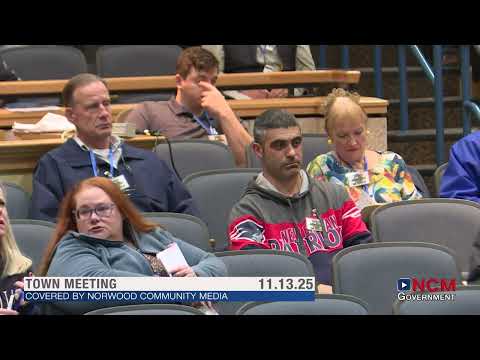
The Finance Commission opened the special town meeting with a detailed presentation on the town’s fiscal picture, noting a historically large certified free cash balance of roughly $24,900,000 and warning that the figure is not sustainable as a recurring revenue source.
Chairman Sullivan told town meeting that the commission had used certified figures and a recently completed capital plan to evaluate requests. The commission reported using $7,500,000 of free cash to balance fiscal year 2026 and said it expects to rely on more than $10,000,000 of one-time funds to maintain level services in fiscal year 2027 if revenue trends continue.
Sullivan and FinCom members emphasized the difference between one-time and recurring budgets and said free cash should be targeted to one-time capital needs and stabilization accounts rather than ongoing operating costs. "If free cash exceeds $5,000,000 the excess should be transferred to a stabilization fund," Sullivan said as the commission urged conservative planning.
On that basis the Finance Commission recommended three primary actions for the special meeting: use a portion of free cash for targeted capital projects; place $2,000,000 into a capital stabilization account; and fund the school department’s special education reserve to the statutory maximum of 2% of net school spending. The commission provided data on sources of the current free cash balance (leftover FY25 funds, unspent appropriations and unusually high investment income tied to prior borrowing patterns) and on near-term capital and operating pressures including rising health insurance, pension and labor costs.
The presentation anchored much of the night’s debate: subsequent articles asked town meeting to approve the recommended transfers and several land purchases the commission argued were consistent with one-time use of funds.
Votes later in the evening approved the special-education reserve transfer, a $2.0 million capital stabilization transfer, and several land purchases; the meeting transcript records detailed debate over timing and fiscal tradeoffs as boards and town meeting members differed on whether to fund reserves now or wait for the annual budget process.