Get Full Government Meeting Transcripts, Videos, & Alerts Forever!
Get email alerts on the Seismic Priority And Bond topic
No spam. Unsubscribe anytime.
Portland SD 1J staff outline seismic prioritization using a 90% seismic‑risk weighted model, say two campuses fit initial bond funding
Summary
Staff presented a hybrid seismic‑prioritization framework tied to the $100 million 2025 modernization bond, using a weighted model (90% seismic risk, 5% facility improvements, 5% enrollment); staff said two full‑campus retrofits fit initial funding and that the programized scope currently projects to roughly $75 million of work within the $100M budget, with design/bid phases likely to expand scope later.
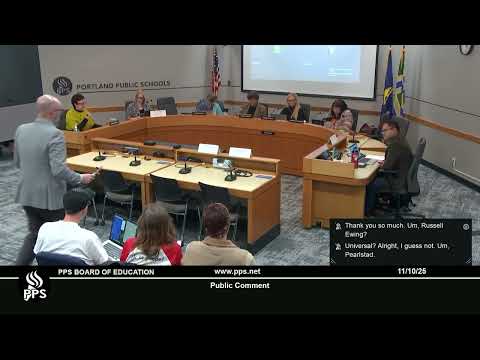
Staff from Portland Public Schools presented a seismic prioritization update to the Facilities Improvement and Oversight Committee on Nov. 10, explaining how the district will use a hybrid approach to use the 2025 school modernization bond to reduce seismic risk across campuses.
John Franco and consultant Jennifer Eggers of Holmes Structures described a weighted scoring model that assigns 90% of prioritization weight to seismic risk, 5% to facility improvements and 5% to enrollment. Eggers said the high seismic weighting reflects the board’s directive to prioritize buildings most at risk, particularly unreinforced masonry (URM) building parts that historically perform poorly in earthquakes. "Unreinforced masonry buildings are well known as high risk building[s]," Eggers said, noting such building parts often land at the top of the risk list.
Under the hybrid approach, staff said the district can plan two full‑campus retrofits within the $100 million bond while using targeted retrofits (for example, URM gymnasiums or specific load‑bearing masonry walls) to extend the program’s reach. Staff estimated the initial programed scope comes to about $75 million of projected work within the $100 million bond, leaving cushion for design uncertainty and potential additional campuses after bidding and grant pursuit (including SRGP grants of roughly $2 million each).
Committee members pressed on equity and data inputs. Per Olstad of the Safe Structures PBS Coalition asked staff to "show your work"—publish the calculations so the public can see how the formula produced the curated list of schools and how equity under Resolution 71‑09 was incorporated. Staff said Title I status and cross‑referencing with past improvements was used to incorporate equity considerations and that rightsizing or consolidation conversations could shift priorities when they occur.
Directors also asked whether geotechnical overlays (liquefaction zones or soil maps) would change prioritization. Jennifer Eggers said staff performed a general overlay and raised site flags where necessary but did not expect more detailed geotechnical study to radically alter the top high‑risk rankings; she said such studies could provide helpful site‑by‑site nuance but would carry additional cost.
Tom Hodges, Chief of Integrated Operations, also reported on maintenance staffing and performance: Facilities currently employs 77 trades FTEs compared with an APPA-recommended 113 FTEs for the district’s scale, a shortfall of roughly 36 FTEs (estimated about $5.4 million). Hodges highlighted improvements in work‑order completion—reporting 95% of work orders completed within service level targets in 2025, up from 85% in 2020—and said staff continue to prioritize Title I and high‑need campuses.
Next steps for the seismic program include securing outside grant support, launching procurement for design services and developing a facility dashboard and draft project list for the first round of work; staff emphasized that final scopes and additional campuses will be refined through design and bidding.