Get Full Government Meeting Transcripts, Videos, & Alerts Forever!
Get email alerts on the Minimum Wage topic
No spam. Unsubscribe anytime.
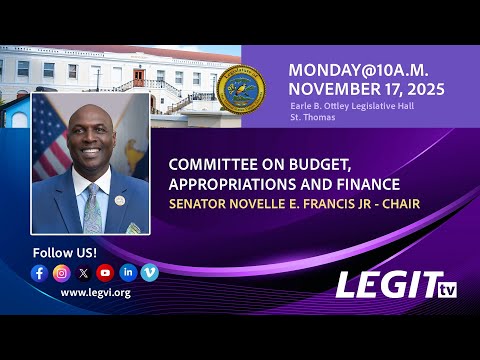
Senate committee advances phased minimum-wage increase to $15 by 2028; moves bill to Rules
Summary
The Senate Committee on Budget, Appropriations and Finance voted to advance bill 36-0030 as amended, approving a three-year, phased increase that would raise the USVI minimum wage to $12 on March 1, 2026, $14 on March 1, 2027 and $15 on March 1, 2028, with an annual COLA beginning in 2029; the measure moves to Rules and Judiciary.
Senators on the Committee on Budget, Appropriations and Finance voted to advance bill 36-0030, an amendment to Title 24 of the Virgin Islands Code that would phase up the territory's minimum wage to $15 an hour over three years and establish an annual cost-of-living adjustment beginning in 2029.
The bill's primary sponsor, Senator Franklin D. Johnson, framed the measure as a correction to years of wage stagnation. "If you walk in the Virgin Islands, you should be able to live in the Virgin Islands," Johnson said in presenting the bill, noting that the current $10.50 minimum wage has not kept pace with local price increases since 2018.
Why it matters: government analysts and labor officials told the committee the territory's buying power eroded substantially after 2018, affecting the lowest-paid workers and contributing to outmigration. The Department of Labor endorsed the phased timetable in its testimony, and the Bureau of Economic Research presented living-wage estimates showing many families still fall short of basic needs.
Testimony and debate
Representatives of the business community urged caution about automatic yearly increases. Scott Barber of the St. Thomas'St. John Chamber of Commerce said the chamber supports raising the wage but recommended a one-time move to $13 an hour rather than automatic escalators tied to uncertain future variables. "The chamber supports an increase from $10.50 per hour to $13 an hour with no automatic increases included in the legislation," Barber said.
Department of Labor Commissioner Gary Malloy told the committee the department supports the phased increases in the most recent amendment and highlighted federal relief that reduces employers' payroll-tax pressure this year. "Under this amendment, the minimum wage would raise to $12 on 03/01/2026, then to $14 on 03/01/2027, and finally, to $15 on 03/01/2028," Malloy said. The department recommended clarifying the formula and index that will determine annual COLA adjustments beginning in 2029.
The Bureau of Economic Research urged a data-driven approach, citing a 2022'23 living-wage analysis. BER director Halden Davies said a staged rise toward $16 by 2029 would better align private-sector pay with the government's existing central-salary benchmarks and the territory's living-cost data.
Numbers and trade-offs
Department of Labor statistics cited during the hearing identify roughly 14,650 private-sector workers currently at or near the minimum-wage level. Witnesses and senators discussed trade-offs including the potential for reduced public-benefit eligibility for some households and the risk that employers might adjust hours, benefits or hiring practices to offset higher labor costs.
Committee action and next steps
After debate and amendment (amendment 36Dot622), the committee voted to report bill 36-0030 favorably and forward it to the Committee on Rules and Judiciary for further consideration. The roll call in committee recorded six votes in favor and one absent. The committee asked staff to provide clarifying language around how the COLA will be calculated and to update fiscal and programmatic impact estimates for the record.
The bill will proceed to the Rules and Judiciary committee, where senators will consider final language and any further changes before the full Senate acts.