Get Full Government Meeting Transcripts, Videos, & Alerts Forever!
Get email alerts on the Homelessness topic
No spam. Unsubscribe anytime.
State and housing providers urge Salisbury to scale housing-first interventions as federal funding tightens
Summary
Maryland DHCD and Health Care for the Homeless told Salisbury's City Council that permanent supportive housing and Housing First strategies reduce homelessness and that a new HUD Continuum of Care NOFO will sharply limit funding available for permanent housing assistance, placing pressure on local efforts and prompting offers of state technical assistance.
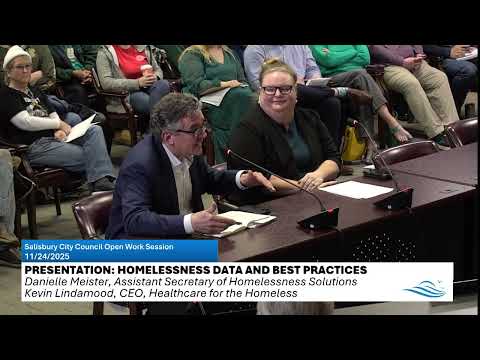
Danielle Meister, assistant secretary for homelessness at the Maryland Department of Housing and Community Development, and Kevin Lindemood, CEO of Health Care for the Homeless, briefed the Salisbury City Council on state supports and local options for addressing homelessness.
Meister told the council the state has "made a lot of progress" toward reducing homelessness and described permanent supportive housing as central to that success. She warned that a recent U.S. Department of Housing and Urban Development (HUD) Continuum of Care NOFO will cap how much permanent housing assistance CoCs can provide, saying that change will mean substantial cuts for the Lower Shore: "for a place like the Lower Shore, it's going to be over $1,000,000 dollars worth of HUD cuts coming in this upcoming calendar year," she said. Meister offered state technical assistance to help Salisbury design a local response and said the state now includes a homelessness preference in the most recent low-income housing tax credit (LIHTC) cycle and has removed a local-match requirement from a Medicaid pilot that can pay for case management.
Kevin Lindemood described Health Care for the Homeless's long use of Housing First and supportive housing, citing retention and health outcomes from program evaluations. He said his organization now supports several hundred households in permanent supportive housing and related interventions and outlined development projects the organization has undertaken or planned, including converting clinics and hotels to housing and using tax credits to expand capacity. "Housing is the only tool that I have seen as a healthcare provider over the last 40 years that is really capable of both improving health and ending homelessness," Lindemood said.
Council members and residents pressed the presenters for concrete local steps. Councilwoman Shield said the city has 34 men in a five-month cold-weather shelter and asked whether state staff could visit Salisbury to evaluate existing assets and recommend local priorities. Meister said the state can provide free technical assistance and coaching on applying for programs and joining Medicaid pilots. The council clerk was directed to collect presenter contact information and schedule follow-up technical-assistance meetings.
Why it matters: Salisbury is a small city with visible homelessness and limited local resources; presenters emphasized that Housing First and supportive housing require upfront investment but produce measurable retention and health benefits. The council asked staff to prioritize data collection and to seek state coaching to map needs, housing types and funding options.
Next steps: State staff agreed to provide existing studies and technical assistance; city staff will coordinate follow-up and share local data with DHCD.