Get Full Government Meeting Transcripts, Videos, & Alerts Forever!
Get email alerts on the Gender Definitions topic
No spam. Unsubscribe anytime.
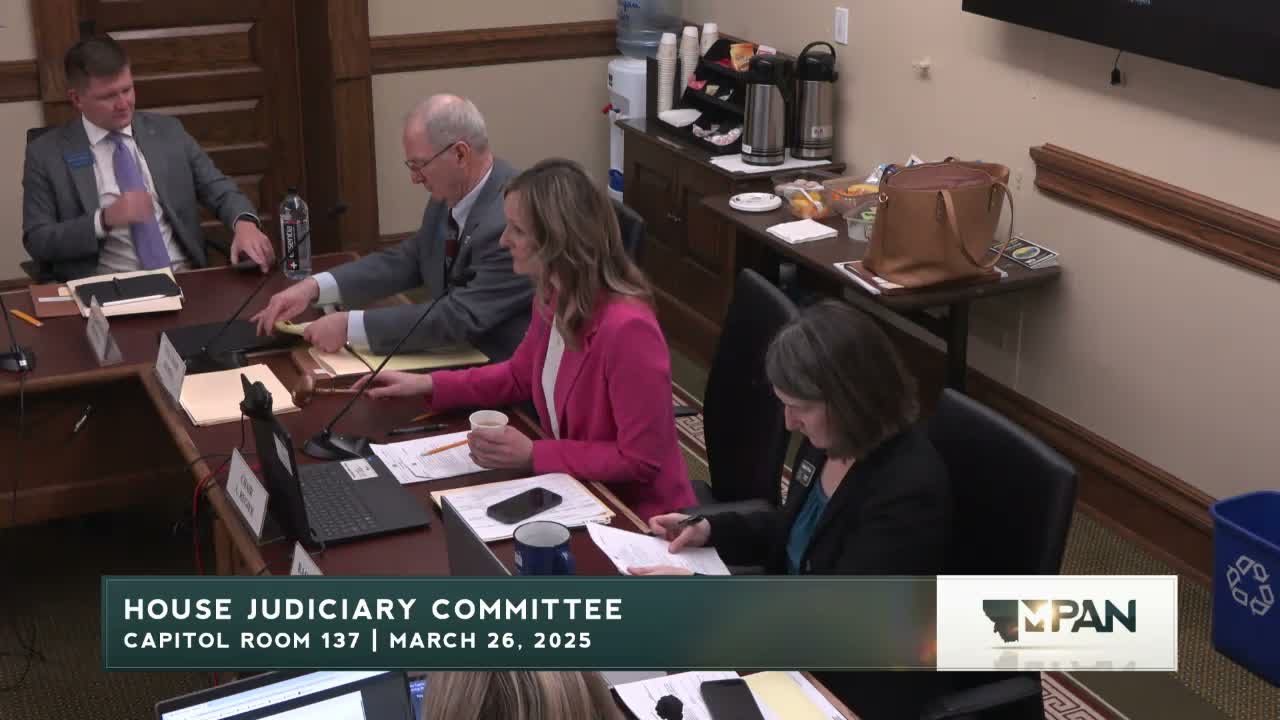
Montana House Judiciary hears contentious testimony on SB 437 to define 'biological sex' in code
Summary
Lawmakers heard hours of pro- and anti-testimony on Senate Bill 437, which would insert definitions for "male," "female," "man," "woman," parents and "biological sex" into Montana law; proponents argued it brings legal clarity, opponents warned it would erase protections for transgender, nonbinary and intersex people and is likely to face litigation.
Senators and witnesses from medical, legal and civil-rights organizations sparred for hours in House Judiciary over Senate Bill 437, which its sponsor, Senator Carl Glimm, said "is about defining terms." Glimm told the committee the measure would add definitions for male, female, man, woman, father and mother into Montana code to ensure those terms "mean the same thing" across statutes.
Proponents framed the bill as a clarity measure. Derek Astraicher of the Montana Family Foundation told the committee the bill "provides legal clarity based on objective science," arguing the legislature — not judges — should define terms used across law and policy. National and national-affiliated witnesses, including Jay Richards of the Heritage Foundation and Matt Sharp of Alliance Defending Freedom, said precise, biologically grounded definitions would protect privacy in prisons, locker rooms and women's sports and align state law with recent federal guidance. Pediatric endocrinologist Quentin Van Meter said clinicians must consider sex-linked differences in growth, disease predisposition and pharmacologic response and warned against conflating sex with gender identity.
Opponents described a different picture. Robin Turner of LegalVoice, the ACLU of Montana, health care providers and numerous individuals testified the bill would "force trans, nonbinary, and Two-Spirit people to either misgender themselves in nearly every legal context or correctly gender themselves and risk penalties" — a formulation Turner said would strip protected groups from anti-discrimination coverage. Witnesses cited litigation history: multiple speakers pointed to court rulings and a district-court summary-judgment order that enjoined the earlier 2023 bill (SB 458), and Anna Tellez, a plaintiff in Edwards v. State of Montana, read the court language saying defendants and their successors are "enjoined from directly or indirectly enforcing SB 4 58 or any law with the same effect."
Medical witnesses including Dr. Jessica McDade (American Academy of Pediatrics-Montana) and Dr. Trent Taylor (Montana Academy of Family Physicians) said the bill misstates biological complexity and would harm intersex people. McDade explained conditions such as androgen insensitivity that can produce anatomy or reproductive potential not aligned with sex assigned at birth, and she warned the bill's reproductive-organ–based definitions would produce "significant difficulties" for those people in everyday life. Advocates for victims' services and prosecutors asked how the bill's rigid definitions could affect criminal statutes and prosecutions.
Committee members pressed witnesses on several fronts: whether the definitions account for intersex conditions, how the measure would interact with the Montana Human Rights Act and existing case law, and whether the new wording would effectively legalize discrimination in employment, housing and health care. Proponents and opponents answered with conflicting legal readings. The ACLU and other opponents emphasized the state court rulings that found a similar bill unconstitutional and warned repeating the same approach would lead to further litigation and expense for the state.
The committee closed the hearing without a floor vote. Senators and representatives signaled further deliberations would follow; no formal action was taken at the end of the session recorded in the transcript.
Ending: The hearing cataloged sharply divided views: sponsors described SB 437 as a technical clarification of longstanding terms, while medical professionals, civil-rights groups and litigants argued the measure is legally fraught and would burden transgender and intersex Montanans. The court history of the earlier bill was repeatedly cited as a practical and legal constraint on advancing substantially similar language.