Get Full Government Meeting Transcripts, Videos, & Alerts Forever!
Get email alerts on the City Finances topic
No spam. Unsubscribe anytime.
Controller and budget director outline COVID-19 spending, hotel contracts and a multi-source funding strategy
Summary
Controller Ben Rosenfield and Mayor's Budget Director Kelly Kirkpatrick presented COVID-related spending estimates, hotel contracting data (about 3,977 hotel units under contract; 90-day estimate ~$35M), FEMA reimbursement expectations, and a rebalancing plan to address projected shortfalls of $180M–$280M.
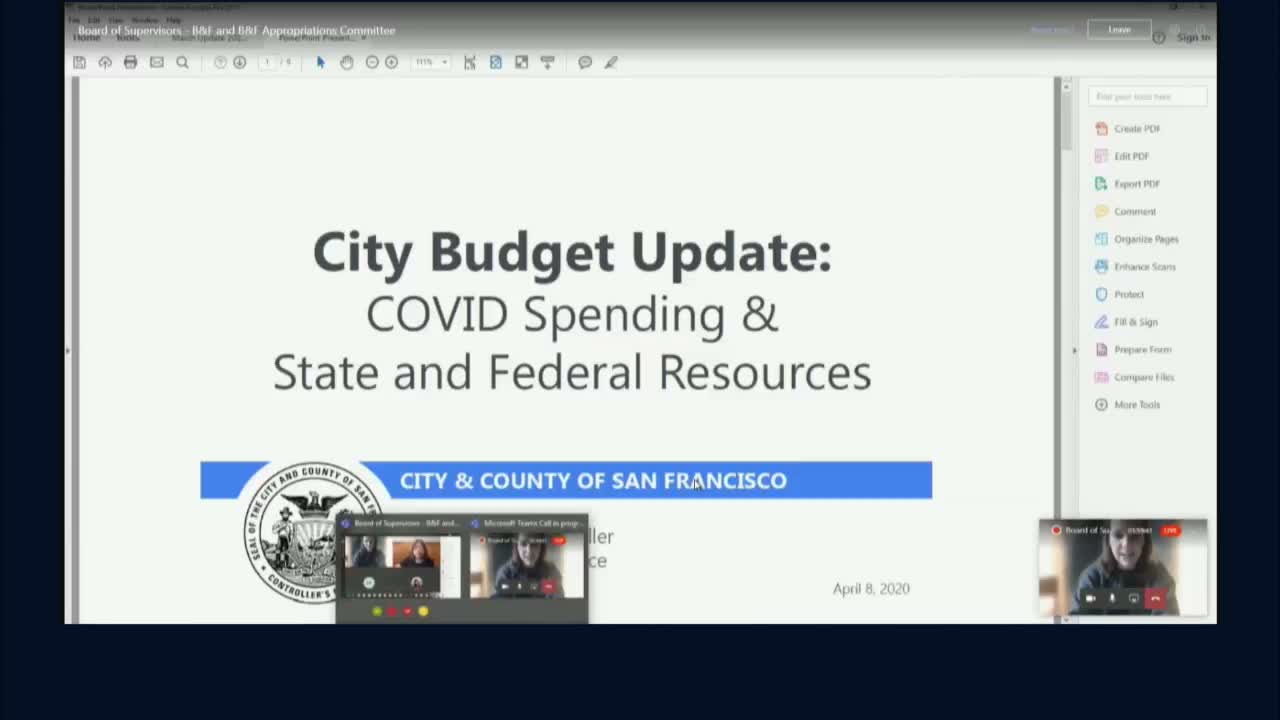
Kelly Kirkpatrick, the mayor's budget director, and Controller Ben Rosenfield briefed the committee on the City's COVID-19 related spending to date, funding sources being tracked, and next steps for financial reporting.
Kirkpatrick said departments are estimated to spend between $50 million and $100 million for core COVID response operations, with about $15 million disbursed so far. The City has contracted for roughly 3,977 hotel units and provided a preliminary 90-day cost estimate of about $35 million for those units, including security and janitorial services. "Our preliminary estimate of those of the cost for the units, for a 90 day period, comes to about $35,000,000," Kirkpatrick said. She added that the City expects approximately $20 million of that to be FEMA reimbursable, depending on whom the units serve.
Controller Rosenfield discussed a broader set of costs including temporary housing, medical surge staffing, testing and PPE, and food-service expansions; he said temporary housing (including hotels) "will be a very significant cost as the city works to respond to the event."
The presenters reviewed federal and state funding possibilities, including FEMA recovery, CARES Act allocations (an estimated $150 million for San Francisco from the Coronavirus Relief Fund), state emergency homelessness funding, and HUD/CDBG resources. Kirkpatrick said rulemaking and eligibility parameters were evolving and noted the CARES Act guidance initially did not include lost revenue backfill.
Supervisors pressed for more granular cost breakdowns. Supervisor Ronan asked for a line-item breakdown of hotel-room, food and staffing costs and noted a local contracting model reportedly delivering beds at about half the City's cost; staff committed to follow up and provide more detailed comparisons and donor reporting for the Give2SF philanthropy fund (Kirkpatrick reported $2.4M received and $6.3M pledged as of April 5).
Kirkpatrick also described an in-progress current-year rebalancing plan to close an anticipated $180M-$280M shortfall and said departmental instructions were issued to limit hiring to essential public-health positions and to evaluate capital project pauses; the administration expected to present rebalancing options in late April/early May.