Get Full Government Meeting Transcripts, Videos, & Alerts Forever!
Get email alerts on the Cash Bail Local Reform topic
No spam. Unsubscribe anytime.
Supervisors Hear Testimony on Money Bail’s Toll on Women and Families; Local Licensing, Revolving Fund Proposed
Summary
At a June 28 committee hearing, city officials, public defenders and dozens of residents described how nonrefundable bail fees and high local bail schedules push families deeper into debt. The treasurer’s office recommended greater oversight, and supervisors signaled actions including a licensing scheme, urging the Superior Court to lower bail, and pursuing SB 10/AB 42 at the state level.
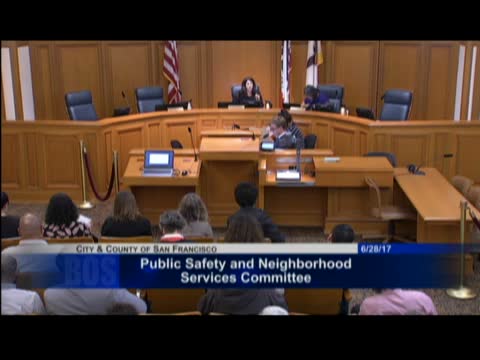
Chair Supervisor Hillary Ronan opened the Neighborhood Public Safety and Neighborhood Services Committee hearing on June 28 to examine how San Francisco’s money bail system affects low-income women and families and to explore local reforms.
The treasurer’s office presented a short report titled “Do the Math: Money Bail Doesn’t Add Up for San Francisco.” Anne Stuhldreher of the treasurer’s Financial Justice Project walked the committee through how the money-bail market works, using a hypothetical $50,000 bond to show that a typical 10% nonrefundable fee can leave families with months or years of payments. Stuhldreher’s presentation repeated her office’s estimate that San Franciscans pay roughly $10–$15 million annually in nonrefundable bail fees and cited increases in consumer complaints to the California Department of Insurance.
Krista Brown, also of the treasurer’s office, outlined five local recommendations: (1) increase oversight of the bail bond industry, including a local regulatory or licensing process for bail agents; (2) lower the bail schedule in cooperation with the Superior Court; (3) explore a nonprofit or public revolving bail fund to post refundable court payments; (4) invest in alternatives to money bail, such as pretrial diversion and case management; and (5) shorten the time people wait in jail after booking, particularly across weekends and holidays.
Sheriff Vicki Hennessy described the operational side: the sheriff’s office does not set statutory bail (that authority rests with the Superior Court), it maintains an intake list of bail agents and requires agents who interview people in custody to sign in. Hennessy said some data — for example exact percentages of people who remain incarcerated solely because they cannot pay bail — are not readily available in current jail systems.
Public Defender Jeff Adachi sharply criticized the broader local system, arguing that San Francisco’s bail schedules are among the highest in the Bay Area and that money-based pretrial conditions drive innocent people to plead guilty. Adachi described large variations across arraignment departments and highlighted racial disparities documented by outside researchers, urging the Board to press for statewide reforms like AB 42 and to fund earlier public-defender involvement at booking and rebooking stages.
Maria McKee of the District Attorney’s Office described the county’s Public Safety Assessment (PSA), an actuarial tool implemented with the court and sheriff’s office. McKee said the PSA has increased prearraignment releases among those eligible (from 29% to 61% in the data presented) and called for independent evaluation of its impact on recidivism, appearance rates and racial disparities.
More than two dozen members of the public spoke during the hearing’s public-comment period. Testimony included detailed personal accounts of families that scrambled to find 10% down payments, examples of long-term debt and credit damage after paying bondsmen, and descriptions of adverse effects on employment, housing and family stability. Speakers representing advocacy groups — including SC Justice Group, Young Women’s Freedom Center, Coalition on Homelessness, Lawyers Committee for Civil Rights and the No New San Francisco Jail Coalition — urged both local oversight and statewide change.
Chair Ronan closed by thanking participants and listing follow-ups: the committee will introduce a Board resolution urging the Superior Court to reconsider the bail schedule and will introduce resolutions supporting AB 42 and SB 10 at the state level. Ronan also said her office will pursue local legislation to increase bail-industry transparency and explore a revolving loan fund to reduce reliance on private, nonrefundable bail payments.
Committee action and next steps: Supervisors asked staff to draft local legislation and pledged to continue the discussion; the committee moved to continue this matter to the call of the chair for follow-up work. The hearing produced clear local priorities — licensing and transparency, support for pretrial services, and coordination with state efforts — but no immediate change to statutory bail rules, which remain set by the courts.