Get Full Government Meeting Transcripts, Videos, & Alerts Forever!
Get email alerts on the Budget topic
No spam. Unsubscribe anytime.
House approves funding adjustments, restores $1 million to Office of Recovery Services in amended HB 1,003
Summary
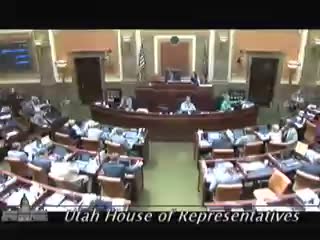
The Utah House on May 20 approved House Bill 1,003 as amended, restoring $1,000,000 in general fund support to the Office of Recovery Services to help replace a failing COBOL-based system and authorizing several agencies to spend designated federal stimulus funds under ARRA; final passage was 63-11.
The Utah House of Representatives voted on May 20 to pass House Bill 1,003 as amended, approving budget adjustments related to Medicaid, education stabilization funds and federal stimulus-authorized spending. The bill, as amended, passed the House by a roll call announced as 63 yes and 11 no and will be transmitted to the Senate for consideration.
Representative Bigelow, who sponsored the amendments and offered the bill’s summary, said the first amendment restores $1,000,000 in state general fund money to the Office of Recovery Services (ORS). According to Bigelow, "the Office of Recovery Services will receive $1,000,000 which will go towards the implementation of this new computerized system," and he said the agency’s current computer system — formerly written in COBOL and reported to have failed on two occasions — needs replacement or a significant upgrade to manage letters, notices and collections.
The amendment’s funding approach reallocates existing sources to accommodate federal restrictions. Bigelow explained the package moves $500,000 from the Medicaid restricted account and directs $500,000 of the governor’s optional federal stimulus funds to a third-party recipient (the Huntsman Cancer Institute) so that the one-time state general fund dollar can be used by ORS for matching or implementation costs. "How's that for a nice accounting solution to a problem of matching funds?" Bigelow said during debate.
A second amendment sponsored by Bigelow authorizes multiple state departments — including transportation, the Department of Health and the Department of Human Services — as well as three public colleges or universities, to spend the federal stimulus monies they receive for their intended purposes, subject to the limits specified in the bill. Bigelow described this as implementing the Legislature’s prior requirement that agencies obtain legislative approval before expending federal stimulus funds.
In his summary of the full bill, Bigelow said HB 1,003 also adjusts state funding levels for Medicaid following a re-estimate of the federal medical assistance percentage (FMAP), reallocates state fiscal stabilization funds for education in line with recent federal guidance, and adjusts authority to extend grants under the American Recovery and Reinvestment Act of 2009 (ARRA). He urged members to support the bill so changes can take effect in time to be implemented, noting some measures may require a two-thirds majority to take effect immediately.
Votes to adopt Amendment No. 1 and Amendment No. 2 were taken by voice and each was announced as passing; the House then proceeded to a final vote on the bill as amended. The Speaker announced that, with all members present having voted, HB 1,003 as amended passed and will be sent to the Senate.
The bill’s immediate practical effects include restored one-time general fund support to ORS earmarked for its case-management system and explicit legislative authorization for agencies to spend specified federal stimulus funds within the limits set by the legislation. The House concluded its consideration and awaited the Senate’s action on the measure.