Get Full Government Meeting Transcripts, Videos, & Alerts Forever!
Get email alerts on the Education Policy topic
No spam. Unsubscribe anytime.
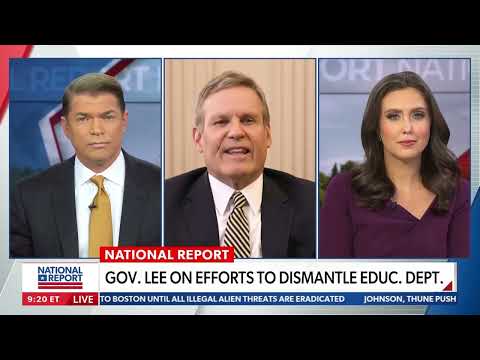
Governor Bill Lee urges state control of K–12 education, criticizes federal 'strings' and promotes parental empowerment
Summary
Governor Bill Lee told interviewers Tennessee should lead on K–12 policy, arguing federal Education Department requirements hamper states, citing a Medicaid waiver savings claim and saying Tennessee has pursued literacy, summer bridge programs and 'universal school choice.'
Governor Bill Lee said education should be governed primarily at the state level and urged giving states more flexibility with federal funds, arguing Washington has added bureaucracy and conditions that he says have not improved outcomes. "There's nothing more important for the future of our country than the future of our children," Lee said.
Lee told interviewers that federal oversight has grown since 1979 and that the Department of Education imposes "strings" and hurdles that, he said, have not benefited students. He framed his position as practical: when states have authority and flexibility over federal dollars, they can use funds "much more efficiently," he said.
As an example of state-level flexibility, Lee said Tennessee negotiated a Medicaid waiver with the first Trump administration that "saved our state and the federal government 1000000000 dollars," a figure he raised in the interview. He also described Tennessee's post-COVID priorities, saying the state pursued targeted literacy efforts, school summer bridge camps and called a special legislative session, and that "our outcomes in Tennessee are ahead of the national average, post COVID," while adding there is still more to do.
Asked whether anything could be done "almost immediately" to improve reading and math scores, Lee compared education to business, saying private-sector organizations use continuous improvement plans and strategic planning each year and that public education should similarly update approaches rather than remain "the same" as decades past. "This is a challenge to the status quo," he said.
On curriculum priorities, an interviewer asked about diversity, equity and inclusion (DEI) in K–12. Lee replied that schools should "go back to the basics"—reading, writing and arithmetic—and emphasized empowering parents in educational decisions. He said he is grateful to the Trump administration and to a federal education official he named in the interview, and added, "In Tennessee, we just passed, universal school choice," framing school choice as part of the state-directed approach.
Lee closed by reiterating his core point that reducing federal conditions on funding and increasing parental authority will better serve students: "When we eliminate the government and empower the parents, we will find success in this country going forward in education."