Get Full Government Meeting Transcripts, Videos, & Alerts Forever!
Get email alerts on the Higher Education Basic Needs topic
No spam. Unsubscribe anytime.
Committee Hears Support for 'Hunger Free Campus' Grants; Lawmakers Seek More Data on Scale and Overlap
Summary
Proponents told the House Workforce and Higher Education Committee that House Bill 157 would help colleges set up on‑site pantries, emergency grants and student resource centers; lawmakers pressed witnesses for clearer statewide data, clarification on funding and whether existing food‑bank networks should administer the program.
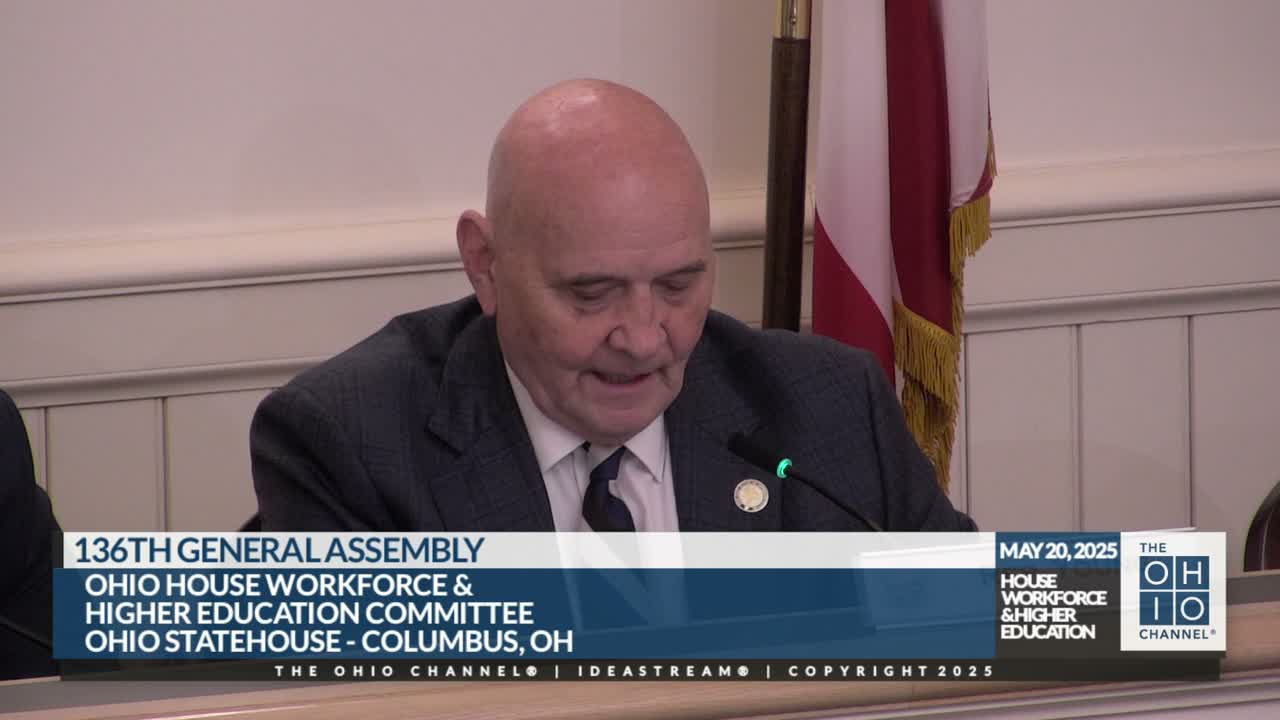
At a hearing of the House Workforce and Higher Education Committee, proponents of House Bill 157, the Hunger Free Campus Act, urged lawmakers to establish a competitive grant program to help Ohio colleges set up on‑site food pantries, emergency assistance grants and student resource centers to address student basic‑needs insecurity.
Supporters described a patchwork of local efforts that leave many students without reliable access to food or other supports. "I urge you all to support HB 157, and pass it out of committee," said Sarah of the Ohio Association of Food Banks, who described partnerships between food banks and more than 30 Ohio institutions and said smaller campuses often lack storage, refrigeration or staff to manage pantries. "This bill would incentivize colleges and universities to establish basic needs programs like an on‑site food pantry or an emergency assistance grant program," she said.
The bill would provide flexible grant funding intended to let campuses tailor programs to their student populations and share best practices. Deacon Nick Bates, director of the Hunger Network in Ohio, told the committee that program flexibility would allow institutions to adapt resources to local needs and to report learning back to the state. Bates cited an example at Capital University: "In 2022 to 2023, they reported serving 170 students through the cap cupboard to overcome the basic needs gap," he said.
Witnesses and lawmakers pressed for better statewide data. Sophie Gephardt, a graduate social work student and intern with the National Association of Social Workers, Ohio, presented survey results and research and told the committee that a 2024 student‑life survey at Ohio State found 32 percent of students reported being food insecure. "Food insecurity disproportionately affects minoritized populations," Gephardt said, and she urged funding and efforts to reduce stigma and increase awareness of available programs.
Committee members repeatedly asked whether the program would duplicate existing services and how it would be administered. Chair Young asked about the proposed appropriation, saying, "The amount of the appropriation, dollars 625,000, in each year," and asked whether existing food bank infrastructure could run reporting or distribution. Bates responded that "1,200,000 is a good start" and emphasized that many local campus pantries need modest funds for staff training, refrigeration or microwaves rather than large, ongoing operating budgets.
Witnesses said HB 157 could also improve data collection and sharing. Sarah and other proponents told the committee the bill would enable campuses to report what services exist on site and allow the state to gather better information about unmet need across different types of institutions. Committee members said they want clearer, consistent measurement before committing larger sums: several representatives asked for evidence that would quantify how widespread and severe student food insecurity is across Ohio's campuses.
Stephanie Dodd, executive director of Community Campus Coalition, said campus resource centers that combine food support with housing referrals, mental‑health connections and emergency aid tend to improve retention and degree completion. Proponents argued those outcomes link the policy to the committee's workforce and higher‑education priorities.
What happens next: witnesses offered to provide the committee with existing data, evaluation reports and lists of campus partners; no committee vote was taken and the House Workforce and Higher Education Committee adjourned without action on HB 157 at the end of the hearing.