Get Full Government Meeting Transcripts, Videos, & Alerts Forever!
Get email alerts on the Hospital Services topic
No spam. Unsubscribe anytime.
Health commission holds Prop Q hearing on CPMCs Mission Bernal labor and delivery closure; requests more data before Nov. 5 vote
Summary
San Franciscos health commission heard DPH and CPMC presentations on the permanent closure of labor and delivery services at CPMC Mission Bernal, received clinician testimony supporting consolidation at Van Ness, and asked DPH/CPMC for ZIP-code birth rates, transportation access, and patient-satisfaction data ahead of a Nov. 5 vote.
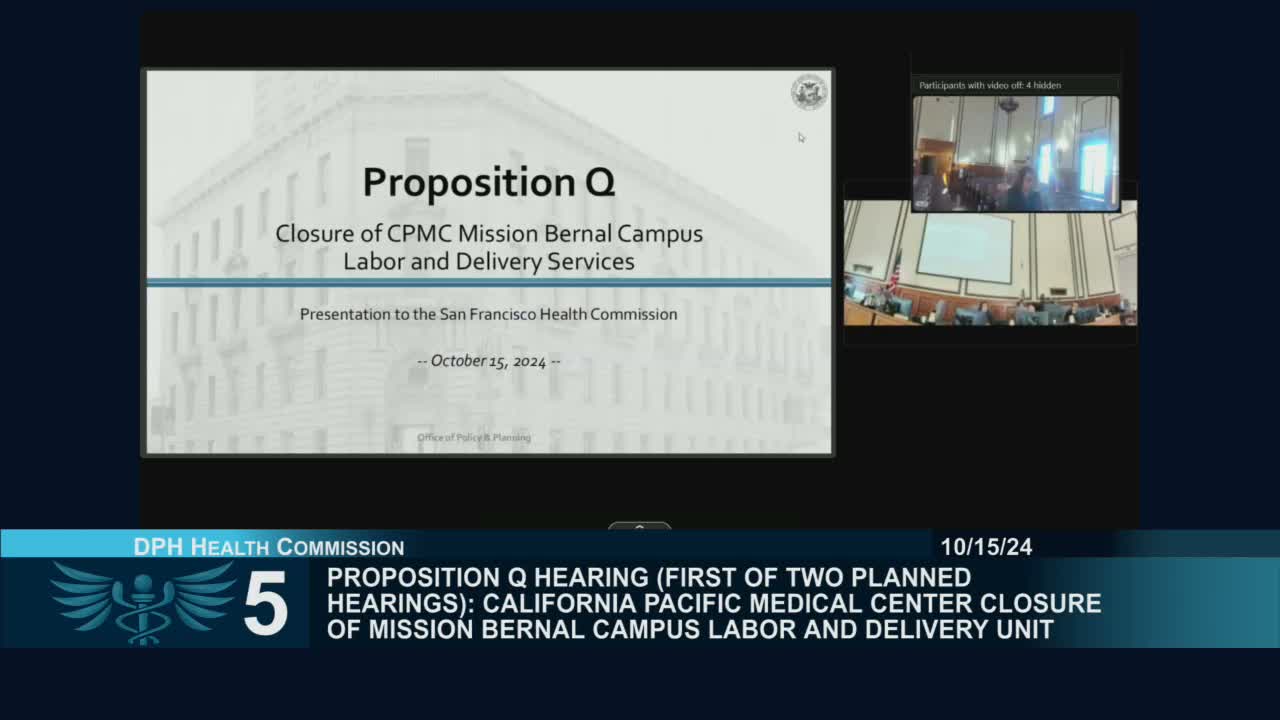
The San Francisco Health Commission on Oct. 15 held the first of two Proposition Q hearings on California Pacific Medical Centers (CPMC) notice of permanent closure of the labor and delivery unit at its Mission Bernal campus.
In a department presentation, Claire Altman, senior health program planner for San Francisco Department of Public Health (DPH), summarized Prop Q (a voter measure passed in 1988), the closure timeline and data analysis. DPH said Mission Bernal accounted for about 7% of city deliveries in 2019 (roughly 800 of some 11,600 city births), served a higher-than-average share of patients who identify as Latinx, Black/African American or multi-ethnic, and had a larger proportion of patients covered by Medi-Cal. DPH reported Mission Bernal had relatively low cesarean and primary cesarean rates and a high VBAC rate compared with other city hospitals, and that breastfeeding-initiation rates were above city and state averages.
CPMC representatives, including Pamela Kaunakim, CPMC CEO, told commissioners the hospital temporarily closed labor and delivery at Mission Bernal in March 2020 for COVID surge planning and later decided not to restore onsite deliveries because volumes remained low (often one to two births per day). CPMC said staff affected by the closure were accommodated at other CPMC campuses, that Van Ness campus has a regional level-3 NICU and maternal-fetal specialists, and that Mission Bernal will continue outpatient womens services. CPMC described plans to convert the former labor-and-delivery floor to medical-surgical and ICU capacity and add imaging, ORs and primary-care space, with construction and service changes planned through 2028.
Clinicians who testified included long-time CPMC obstetrics leaders and a neonatologist who supported consolidation to higher-volume centers. Michael Katz, former CPMC chief of obstetrics, said consolidation supports higher-quality, team-based care; Dr. Karen Callan and others cited literature and local experience indicating higher risks at low-volume delivery units.
Commissioners pressed DPH and CPMC for more detailed evidence before the board votes at the second hearing on Nov. 5. Requests included: ZIP-code-level birth-rate trends for affected neighborhoods; the text and results of patient-satisfaction surveys and the national questionnaire vendor used; clarification of transportation offerings and how patients request and access them; and data describing whether outcomes and access remain equivalent for communities that historically used Mission Bernal. DPH and CPMC agreed to provide follow-up materials and to circulate draft resolution language incorporating a patient-safety whereas clause for review before the Nov. 5 hearing.
The commission did not take a final vote on the proposition at the Oct. 15 meeting; the next hearing and anticipated vote are scheduled for Nov. 5.
Ending: DPH and CPMC committed to provide the requested ZIP-code and patient-satisfaction data, transportation-access details and draft resolution language ahead of the Nov. 5 vote.