Get Full Government Meeting Transcripts, Videos, & Alerts Forever!
Get email alerts on the Mental Health Screening topic
No spam. Unsubscribe anytime.
Uxbridge counseling team reports universal screening pilot results, cites $50,000 3-11 grant support
Summary
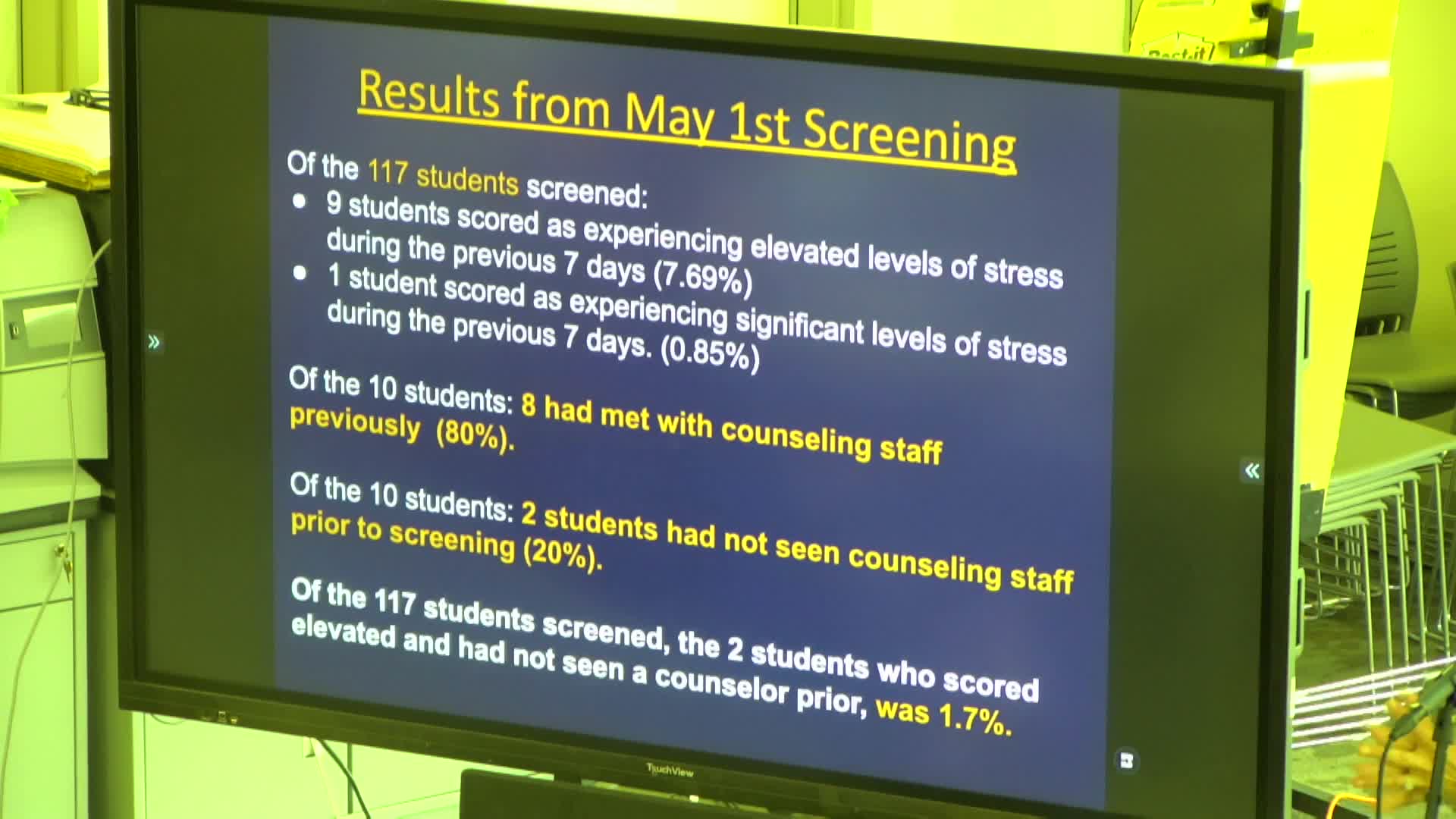
District counselors told the committee they screened 117 seventh-graders May 1 as part of a universal screener pilot funded by a $50,000 '3 11' grant; 10 students scored at elevated or significant stress levels, eight of whom already had counseling contact. Presenters described counseling services, GoGuardian alerts and plans to reassess students in grade 10.
District adjustment counselors gave the Oxford School Committee a detailed presentation about the district’s mental-health supports and a universal screening pilot funded by the "3 11" grant.
Presenters said the screening pilot targeted seventh graders. "On May 1, we screened 117 students, seventh grade students," a presenter reported, and described screening outcomes: "9 scored experienced, elevated levels of stress during the past 7 days. 1 student scored as experienced significant levels of stress… Of those 10 students, 8 had already met with counseling staff," and two students had not previously been seen by counselors (SEG 601–614). Counseling staff said they contacted families of students who scored elevated and are providing goal-based counseling.
The presentation outlined the range of counseling services — individual and group counseling, lunch bunches, crisis intervention and consultative work with teachers — and described several screening tools that have been used in the district over time, including the YRBS, PHQ‑9, GAD‑7 and SBIRT. Presenters emphasized that a universal screener is a "snapshot in time" and that follow-up reassessment is planned (presenters said grade 10 would be used to reassess the cohort).
Presenters explained uses of the 3 11 grant: technical assistance and consultation from DESE, professional development for clinicians, and supports to run the universal screening pilot. "So this year the 3 11 grant was split between our consultation work and our universal screener work and it was a $50,000 grant," a presenter said (SEG 1350–1356). The team said they hope to reapply and expand activities districtwide if funding is available.
Counselors also described operational practices and supports: use of GoGuardian (an online monitoring tool that routes flagged screenshots to staff for triage), mentoring and wellness clubs, a stress-management class at the high school, and classroom-level SEL strategies (MTSS, zones of regulation and embedded tier‑1 work). The presenters stressed that most students identified by screening had preexisting connections to counseling staff, and that the pilot helps the district plan supports and measure interventions over time.
The committee asked about question wording and family notification; presenters said families of flagged students were contacted promptly and that the screener used a short, age-appropriate, seven-day reference frame to reduce leading responses and capture recent experiences.