Get Full Government Meeting Transcripts, Videos, & Alerts Forever!
Get email alerts on the Election Transparency topic
No spam. Unsubscribe anytime.
Former state senator tells House panel gaps in records and audits undermine confidence in Michigan elections
Summary
Patrick Kolbeck, a former Michigan state senator, told the House Committee on Election Integrity that inconsistencies across precinct-level records, the Qualified Voter File and audit procedures raise questions about the accuracy and integrity of recent elections and urged subpoenas and federal investigations.
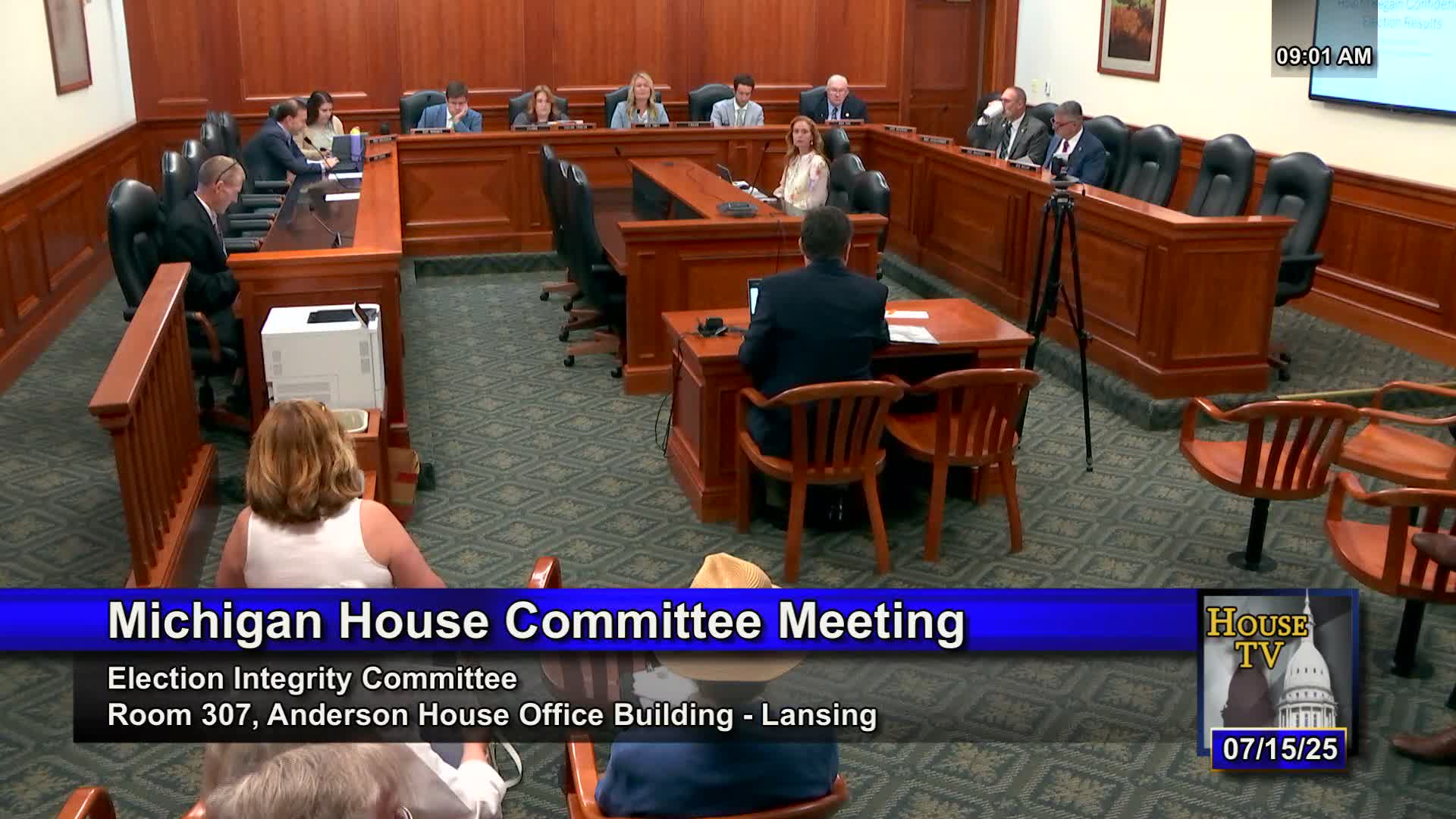
Patrick Kolbeck, a former Michigan state senator, told the House Committee on Election Integrity that ‘‘an accurate election conducted with integrity would reveal consistency between’’ precinct-level records and statewide totals and urged lawmakers to seek more detailed records and stronger audit standards. Kolbeck spoke at the committee hearing after Chair Smith introduced him to discuss election transparency.
Kolbeck outlined what he called the ‘‘key election records’’ voters need to trust results: the number of voters and ballots cast by precinct and voting method; poll books and voter lists; ballot images and cast vote records; and the official tabulated results. ‘‘Trustworthy, precinct-level data is what is needed in order to trust the integrity of our election systems,’’ he said.
He cited several examples he said show potential problems: precincts the committee’s witness described as ‘‘unbalanced’’ when voter counts did not match ballots; a recount incident in Detroit that he said found 50 ballots in a container while an associated statement recorded 306; and what he described as more than 350,000 fewer voter histories in the Qualified Voter File than ballots reported cast in the 2020 presidential election. Kolbeck called those discrepancies ‘‘indicators’’ that warrant deeper review but characterized his claims as the basis for formal investigations rather than final findings.
Kolbeck also raised concerns about audit scope. He said risk-limiting audits examine a limited set of records and ‘‘don’t look at whether or not these voters are actual eligible voters,’’ arguing that broader audits that include poll books and chain-of-custody evidence are necessary. On the format of reported results, he warned that reporting as decimal fractions rather than whole integers introduces avoidable risk of misinterpretation.
The witness leveled allegations about actions by state officials and private organizations that he said undermine public confidence, including claims that the secretary of state had resisted disclosure of training materials and that some courts had found aspects of guidance unlawful. He also alleged an $82,500 donation from a political committee he connected to Secretary of State Jocelyn Benson to a candidate for the Michigan Supreme Court and said he had filed complaints with oversight bodies; he described those matters as pending investigations.
Kolbeck closed by offering legislation and subpoenas he favors: statutory transparency for chain of custody, a subpoena for the QVF transaction log, stronger audit standards and FOIA reforms. He also urged the legislature to request federal investigations under Executive Orders 13873 and 14248 into voting-system components and related questions.
Committee members pressed Kolbeck on evidence and next steps. Chair Smith and others asked why access to the QVF transaction log had been denied; Kolbeck said the typical response cites security and that redactions could address PI concerns. Representative Altman pressed for evidence supporting the donation allegation; Kolbeck said he had filed complaints that had been appealed and that federal authorities were now involved.
The committee did not make a formal finding at the hearing. Kolbeck said he had documentation he would provide to members on request and invited further questions. The committee proceeded to take up other bills on its agenda.